All posts by ajaxtrueblood

I’m not ISIS…

I swear…

costume

Funny story.  So, a few months ago, I’m scanning around on Facebook, trying to connect with various 3/2 veterans. Sending out friendship requests, sending chat messages. Gotta admit, I’m still a noob on FB, so sometimes I fumble around a bit.  Anyway, as I start chatting with one guy, he starts getting squirrelly with me, really suspicious.  He’s asking, how do I know who you say you are?  And as I try to answer this (kinda hard if you think about it), suddenly a strange message pops up on my ‘timeline’.  It says:

NICE TRY ISIS!!!

I’m baffled at first. It didn’t come from the guy I’m chatting with, but some other dude I’ve never heard of.  I keep chatting (by now I’m in about 3 simultaneous chat sessions w different guys), and it slowly dawns on my that they’ve been chatting with each other, checking me out.  One of their buddies was apparently getting hammered at a bar somewhere, and fired off that message from his cell phone.

Then the original guy kind of explains whats going on, and why they’re suspicious. We end up having about a 45-minute phone call that night, and I answer a bunch of his questions.  He’s kind of ‘extreme vetting’ me.  And I get it, there’s lots of weirdos and kooks on the interwebs, so I don’t mind.  We actually had a pretty good talk, and he wants me to talk w another of his buddies. So next day I pretty much go through the ringer again with another guy.

Oh, and in the meantime, I erased the drunk guy’s post from my timeline… That didn’t seem like a good thing to leave up there…

Lessons learned:

  • I need to be a bit more careful when I contact someone out of the blue, especially on Facebook. It’s kind of hard not to sound sketchy through a little chat window.  I’ve actually scaled back on my Facebook ‘outreach’ efforts.
  • I need to be prepared to answer some probing questions from these vets.  I can’t blame them, really.  I might be leery if someone I’d never heard of texted me late at night, asking about my deployments.
  • Never under-estimate the speed and reach of social media. Literally within minutes, I had introduced myself to one guy, started chatting with several others in his unit, then got denounced as a terrorist.  All between commercials.

But there’s also a lesson for you other 3/2 guys:

I backed off my efforts to contact that unit for quite a while. At the same time, other sources were being very open, sharing great info.  For the next few months, I pushed my efforts in their direction, and then switched to yet another unit. I’m kind of fluid that way, I’ll follow the leads and sources that present themselves.

I still want to get back in contact with those guys that were ‘extreme vetting’ me that night, because they’ve got an important part of 3/2’s story.  And I think that’ll happen soon.  But, my telling their story will depend on the confidence they choose to place in me and their cooperation.

Anyway, gotta run. Time for morning prayers at the mosque… (that’s a joke, btw)

–Ajax


The 6-Way War

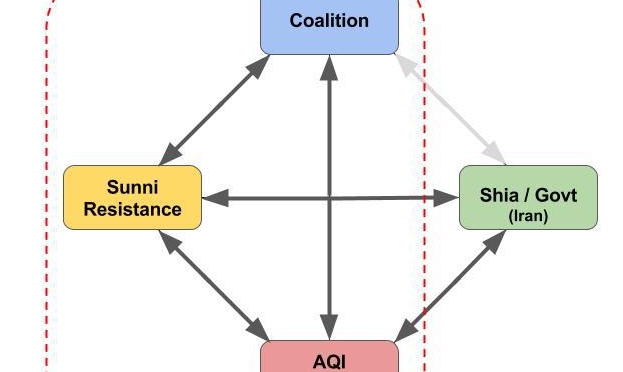
4-way graphic
The red dotted line shows the operative dynamics in Anbar Province in 2005. Gray arrow depicts the latent conflict between the Coalition and Iranian-sponsored Shiite militia groups.

I’m changing the title again, cause ‘6-Way War’ sounds a little catchier, kind of like the famous ‘6-Day-War’… Don’t know, may change it again…

Anyway, this is a section I’ve been mulling over in my mind for some time, and its time to put it together.  I think this is a good way to encapsulate the multifaceted, diabolically confusing Iraq War.  To boil it down, there were four major ‘factions’, each struggling against the other three.

Hopefully this nifty graphic makes some sense.  While there are four ‘sides’, there are actually 6 separate ‘axes’ of conflict:

  • Coalition vs. Sunni ‘resistance’
  • Coalition vs. AQI / Jihadists
  • Sunni ‘resistance vs. AQI/Jihadists
  • AQI vs. Shia / government / Iran
  • Sunni ‘resistance’ vs. Iranian/Shiite government
  • Coalition vs. Iranian Influence

And yes, I left out the Kurds and the Turkomen, to keep it under control…

Here’s the way I think I’ll approach this, in outline form:

The Marine Corps “strategic corporal” and “three-block-war” ideas.  Background and explanation.  New demands on small unit leaders and individual Marines.

Explain the 6-Way War concept and graphic.

Coalition vs. Sunni resistance – upon arrival in Al-Qaim this was the main conflict for 3/2.  Security and Stability Ops. Conventional force vs. insurgents. As deployment progressed, this began to morph.

Coalition vs. AQI/Jihadists – The main Coalition command responsible for this fight was the JSOC Task Force 714, General McChrystal’s outfit. It was a parallel, but separate war in many respects, with Delta, SEAL Teams, and Rangers hunting for high-value targets (HVTs) across Anbar, including in 3/2’s battlespace.  But as 3/2 got on the ground, it also started engaging AQI as its main enemy. And as local insurgents turned against AQI, 3/2 (especially India Co.) became enmeshed in this dimension of the war.

Sunni resistance vs. AQI – Also known as ‘red on red’.  This was a major theme during 2005 in Al-Qaim. Local insurgents (Albu Mahal tribesmen, then others) rejecting AQI’s tyrannical, terroristic rule. And ultimately calling on 3/2 Marines for help, which was the first part of the Sunni ‘Awakening’ process that changed Anbar so dramatically the following year.

AQI vs. Shiites, the Shiite led government and Iranian influence. – Zarqawi and his followers had a visceral hatred towards the Shia, and targeted them mercilessly. Since there aren’t many Shiites in Anbar, this wasn’t a prominent dynamic in 3/2’s AO, but it played out through AQI’s use of western Anbar and the ratlines to funnel suicide bombers and other so-called “accelerants” east into Bagdhad and areas where the Shia lived and worshipped.

Sunni resistance vs. Shiite & Iranian influence – This was also a secondary factor in 3/2’s AO, but did play a role. Some 3/2 Marines saw the ugliness of this sectarian hatred in various ways.  Chris Ieva’s walk through the angry Sunni crowd, along with Shiite Shawani SOF guys, is a dramatic example.

Coalition vs. Iranian influence. – Didn’t really figure directly into 3/2’s fight in 2005, as there were no Shiite militias in Anbar.  This wouldn’t become a big factor until after AQI’s bombing of the Samarra Mosque in early 2006, when JAM and Shiite death squads would become another enemy the Coalition would have to fight.

–Ajax

Firefight at Trash OP

Here’s an excellent video showing a firefight at “Trash OP”, situated on the north side of Husaybah and manned by India Company.  After you view it, see my amplifying comments below (***language warning***)

I don’t know the names of these Marines, yet. Hopefully I’ll have that info soon…

There’s a few things to note here.  First, this wasn’t random firing at all. They’d just been shot at by insurgents, and returned fire.

Second, the sheer exuberance of the Marines was typical. Most grunts in India Co. actually looked forward to a rotation at Trash OP, because it was likely they’d get into a firefight. This is hard for many to understand, but it’s indicative of the aggressive attitude among Marines in combat.

Third, even though it may seem like the firing starts to get out of control, and the Squad Leader struggles for a few seconds to get his Marines to cease fire, that is very common in combat. The noise of modern firearms can easily drown out verbal orders.  Actually, he quickly gets the firing under control, gets on the radio to coordinate further actions, and the squad gets water to cool the MG barrels down, prepping for the next engagement. Even though there’s some hootin’ and hollerin’, their actions are efficient and professional.

Finally, notice that somebody suggests they leave the expended brass where it lies, to impress the next squad with the firefight’s intensity. But the Squad Leader says, no, “We’ll police it all up. We have to, we live here!”  Another sign of professionalism and discipline.

–Ajax


Blowing up the Bakery

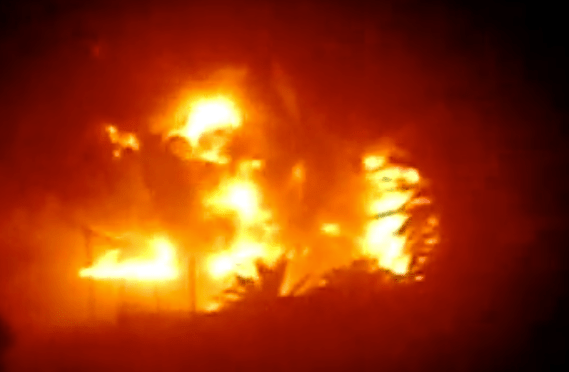
This is a great video of a nighttime AT-4 launch from the Trash OP into Husaybah, responding in kind to insurgents launching RPGs at the outpost.  I’ve researched this, and am quite sure this happened on the night of 25 June 2005.  Will Marconi has confirmed it was he and his guys, 1st Squad, 1st Plt, India Co, that fired it.

In the background you’ll hear Will yell “Beautiful!” after the  explosion. (***language warning***).  Then below, read his first-hand description of the whole incident and the aftermath…

As background, there had been a lot of action that day, with insurgents in the city engaging Trash OP from various buildings. The firefights intensified that night, involving three different elements; Marconi’s squad in their heavily sandbagged position, 2nd Platoon posted at the ING compound, and a Scout/Sniper team operating from a hide site within the city.  For some reason, that night the insurgents had decided to test the Marine positions with more than the usual pot shots. Gunfire echoed from multiple engagements, while tracers crisscrossed over the northern part of the city.  An RPG round suddenly streaked towards the OP, exploding short of 2nd Squad’s position. Then another exploded behind them.

Will Marconi, then a Corporal and Squad Leader, recalls:

It was my squad at the OP that night.  Ronnie Jackson actually saw the RPG launch when it happened, so knew exactly where it came from.  It landed about 100 meters short of us.  A few minutes later, another RPG hit behind us, like they were bracketing us.  I was getting concerned for our safety.  

We kept two AT-4 rockets out there, to counter possible VBIED attacks, but I decided we needed to use one of them to respond. Our MGs and M-16s just weren’t having good effects.  Normally we’d have to get permission for an AT-4 launch, but I couldn’t get on the radio.  2nd Platoon was also engaged, and the radio was clogged with traffic.

I’m sure it was LCpl Hartsock that fired the AT-4.  He was given an award for it later. He was the only one in squad who had fired a live AT-4 in training.  I gave Jackson my tracer mag and had him mark the target, while I had everyone else cease fire.  Then Hartsock had to get outside the sandbags, exposed to incoming, since he couldn’t fire it inside the OP because of backblast danger.  When he stood up, I ordered everyone to cover for him, lay down suppressive fire.

When the AT-4 hit the house, it blew and then flames shot way up. I was astonished at how big the explosion was. It was pretty wild. At the time, we thought we’d hit an arms cache or something the way it went up like that. It wasn’t the normal effect an AT-4 would have. Something in that house exploded, and there were flames everywhere. It seemed like the whole street caught on fire.  The flames were lighting everything up, and you could see guys running around.  

The flames illuminated the insurgents and made them vulnerable. They were in a crossfire from us, the ING and from the snipers.  Some were running away, but some were running forward to fire at us.  I remember talking to a Reaper guy years later, and he said they shot one guy who was moving forward with a backpack full of RPG rounds.  

So the fire made it hard for the insurgents to move around. That AT-4 turned the tide that night, and there wasn’t much firing at us after that.  We were supposed to be relieved that night by another squad, but all the firing delayed that.  A couple hours after the AT-4, we did get relieved and went back to Gannon.  

As soon as I got back, I was told Capt Diorio wanted to have an AAR with us so my PL, Lt Brummond, and I went over to the COC.  The LT was worried because I hadn’t coordinated the shot over the radio. We were supposed to get permission.  But the radio had been jammed, so I couldn’t get a call through. I used my own judgement.  

When we got into the COC, the Captain says, “Marconi, what do you have against Dunkin’ Donuts?”  That’s when we found out it was a bakery.  Locals were already calling in complaints because it was destroyed.  Other shop owners had their shops burning too, so it was a big deal.

But we knew the RPGs had come from there. No doubt. And us shooting that AT-4 pretty much ended the fight. I thought maybe I was in trouble, but I just explained what happened. I still remember Capt. Diorio’s response.  He told me, “Corporal Marconi, I want you to know I will not judge you for decisions on the battlefield. However, I need to know what happens on the battlefield, to adjust our tactics. So relax, you’re not in trouble. You did the right thing.”

1st Sgt Donnie Brazeal was cool about it too.  There were still flames burning on the skyline in north Husaybah, and Brazeal said, kind of joking, “Ain’t that the purtiest thing you’ve ever seen?”.  That’s the way he was, 1st Sgt Brazeal was always about supporting his Marines, and bringing everyone home.  That’s the night I realized my leaders had my back, and that India Co. was a special outfit.  

–Will Marconi, interview with author (used with permission)

Happy 242nd Marines!

usmc-bday-2017At first I just posted the standard 2017 Birthday Message (below), but I like this one better. Not sure what unit it came from, but it shows Marines at a checkpoint in Iraq, probably around 2006 or so.  The bored grunt says “Let the insurgents know that Sierra Deuce is on Bugs and we’ll be here for an hour. We wanna play. Tell em to quit being pussies and cowards, and come out and shoot at us”…  Classic!


Understanding the Few Good Men

Col Cooling
Norman L. Cooling

Part of my research process has been an effort to better understand Marine Corps attitudes, organization, doctrine and “culture”.  Here’s a really good resource I found, written by two senior Marine officers, Norman L. Cooling and Roger B. Turner.  Their article is Understanding the Few Good Men: An Analysis of Marine Corps Service Culture.

Col Turner
Roger B. Turner

At the time Cooling was a Colonel and Turner was a LtCol.  Both reached Brigadier General, but I’m not sure about their current rank or status. I’m not sure where it was first published, but it looks like it was done for a military journal.  Anyway, I found it enlightening…

–Ajax


Video: AT4 as garage door opener

The AT4 rocket system is one of the basic infantry weapons used by US Marine infantry units, giving platoons and squads a potent weapon for engaging light armored vehicles, bunkers and fortified positions. It’s simple, man-portable and disposable after launch. But it packs quite a punch when correctly employed.

Here’s a video showing US Army Special Forces soldiers in Afghanistan, apparently using some old storage sheds for AT4 target practice with dramatic results.  Enjoy the show!
(language warning)

Zarqawi’s 2004 letter to Al-Qaida

Zarqawi-VideoIn February 2004, the Coalition Provisional Authority (CPA) in Iraq translated and released a letter from Abu Musab al-Zarqawi to the leadership of Al-Qaida.  In the letter, Zarqawi lays out his strategy to ignite civil war, particularly by targeting the Shiites in Iraq.

Below is the translation:

1. The foreign Mujahidin: Their numbers continue to be small, compared to the large nature of the expected battle. We know that there are enough good groups and jihad is continuing, despite the negative rumors. What is preventing us from making a general call to arms is the fact that the country of Iraq has no mountains in which to seek refuge, or forest in which to hide. Our presence is apparent and our movement is out in the open. Eyes are everywhere. The enemy is before us and the sea is behind us. Many Iraqis would honor you as a guest and give you refuge, for you are a Muslim brother; however, they will not allow you to make their homes a base for operations or a safe house. People who will allow you to do such things are very rare, rarer than red sulfur. Therefore, it has been extremely difficult to lodge and keep safe a number of brothers, and also train new recruits. Praised be to Allah, however, with relentless effort and searching we have acquired some places and their numbers are increasing, to become base points for the brothers who will spark war and bring the people of this country into a real battle with God’s will.

2. The present and future: There is no doubt that American losses were significant because they are spread thin amongst the people and because it is easy to get weapons. This is a fact that makes them easy targets, attractive for the believers. America, however, has no intention of leaving, no matter how many wounded nor how bloody it becomes. It is looking to a near future, when it will remain safe in its bases, while handing over control of Iraq to a bastard government with an army and police force that will bring back the time of [Saddam] Husayn and his cohorts. There is no doubt that our field of movement is shrinking and the grip around the throat of the Mujahidin has begun to tighten. With the spread of the army and police, our future is becoming frightening.

3. So where are we? Despite few supporters, lack of friends, and tough times, God has blessed us with victories against the enemy. We were involved in all the martyrdom operations — in terms of overseeing, preparing, and planning — that took place in this country except for the operations that took place in the north. Praised be to Allah, I have completed 25 of these operations, some of them against the Shi’a and their leaders, the Americans and their military, the police, the military, and the coalition forces. There will be more in the future, God willing. We did not want to publicly claim these operations until we become more powerful and were ready for the consequences. We need to show up strong and avoid getting hurt, now that we have made great strides and taken important steps forward. As we get closer to the decisive moment, we feel that our entity is spreading within the security void existing in Iraq, something that will allow us to secure bases on the ground, these bases that will be the jump start of a serious revival, God willing.

4. Plan of action: after much inquiry and discussion, we have narrowed our enemy to four groups:

A. Americans as you know, these are the biggest cowards that God has created and the easiest target. And we ask God to allow us to kill, and detain them, so that we can exchange them with our arrested shaykhs and brothers.

B. Kurds, these are a pain and a thorn, and it is not time yet to deal with them. They are last on our list, even though we are trying to get to some of their leaders. God willing.

C. The Iraqi troops, police, and agents these are the eyes, ears, and hand of the occupier. With God’s permission, we are determined to target them with force in the near future, before their power strengthens.

D. The Shi’a in our opinion, these are the key to change. Targeting and striking their religious, political, and military symbols, will make them show their rage against the Sunnis and bear their inner vengeance. If we succeed in dragging them into a sectarian war, this will awaken the sleepy Sunnis who are fearful of destruction and death at the hands of these Sabeans, i.e., the Shi’a. Despite their weakness, the Sunnis are strong-willed and honest and different from the coward and deceitful Shi’a, who only attack the weak. Most of the Sunnis are aware of the danger of these people and they fear them. If it were not for those disappointing shaykhs, Sufis, and Muslim brothers, Sunnis would have a different attitude.

5. Way of action: As we have mentioned to you, our situation demands that we treat the issue with courage and clarity. So the solution, and God only knows, is that we need to bring the Shi’a into the battle because it is the only way to prolong the duration of the fight between the infidels and us. We need to do that because:

A. The Shi’a have declared a subtle war against Islam. They are the close, dangerous enemy of the Sunnis. Even if the Americans are also an archenemy, the Shi’a are a greater danger and their harm more destructive to the nation than that of the Americans who are anyway the original enemy by consensus.

B. They have supported the Americans, helped them, and stand with them against the Mujahidin. They work and continue to work towards the destruction of the Mujahidin.

C. Fighting the Shi’a is the way to take the nation to battle. The Shi’a have taken on the dress of the army, police and the Iraqi security forces, and have raised the banner of protecting the nation, and the citizens. Under this banner, they have begun to assassinate the Sunnis under the pretense that they are saboteurs, vestiges of the Ba’ath, or terrorists who spread perversion in the country. This is being done with strong media support directed by the governing council and the Americans, and they have succeeded in splitting the regular Sunni from the Mujahidin.

For example, in what they call the Sunni triangle, the army and police are spreading out in these regions, putting in charge Sunnis from the same region. Therefore, the problem is you end up having an army and police connected by lineage, blood and appearance to the people of the region. This region is our base of operations from where we depart and to where we return. When the Americans withdraw, and they have already started doing that, they get replaced by these agents who are intimately linked to the people of this region. What will happen to us, if we fight them, and we have to fight them, is one of only two choices:

1) If we fight them, that will be difficult because there will be a schism between us and the people of the region. How can we kill their cousins and sons and under what pretext, after the Americans start withdrawing? The Americans will continue to control from their bases, but the sons of this land will be the authority. This is the democracy, we will have no pretext.

2) We can pack up and leave and look for another land, just like it has happened in so many lands of jihad. Our enemy is growing stronger day after day, and its intelligence information increases. By God, this is suffocation! We will be on the roads again. People follow their leaders, their hearts may be with you, but their swords are with their kings. So I say again, the only solution is to strike the religious, military, and other cadres of the Shi’a so that they revolt against the Sunnis. Some people will say, that this will be a reckless and irresponsible action that will bring the Islamic nation to a battle for which the Islamic nation is unprepared. Souls will perish and blood will be spilled.

This is, however, exactly what we want, as there is nothing to win or lose in our situation. The Shi’a destroyed the balance, and the religion of God is worth more than lives. Until the majority stands up for the truth, we have to make sacrifices for this religion, and blood has to be spilled. For those who are good, we will speed up their trip to paradise, and the others, we will get rid of them.

By God, the religion of God is more precious than anything else. We have many rounds, attacks, and black nights with the Shi’a, and we cannot delay this. Their menace is looming and this is a fact that we should not fear, because they are the most cowardly people God has created. Killing their leaders will weaken them and with the death of the head, the whole group dies. They are not like the Sunnis. If you knew the fear in the souls of the Sunnis and their people, you would weep in sadness. How many of the mosques have they have turned in to Shi’a mosques (“husayniyas”)? How many houses they have destroyed with their owners inside? How many brothers have they killed? How many sisters have been raped at the hands of those vile infidels?

If we are able to deal them blow after painful blow so that they engage in a battle, we will be able to reshuffle the cards so there will remain no value or influence for the ruling council, or even for the Americans who will enter into a second battle with the Shi’a. This is what we want. Then, the Sunnis will have no choice but to support us in many of the Sunni regions. When the Mujahidin would have secured a land they can use as a base to hit the Shi’a inside their own lands, with a directed media and a strategic action, there will be a continuation between the Mujahidin inside and outside of Iraq.

We are racing against time, in order to create squads of Mujahidin who seek refuge in secure places, spy on neighborhoods, and work on hunting down the enemies. The enemies are the Americans, police and army. We have been training these people and augmenting their numbers.

As far as the Shi’a, we will undertake suicide operations and use car bombs to harm them. We have been working on monitoring the area and choosing the right people, looking for those who are on the straight path, so we can cooperate with them. We hope that we have made progress, and perhaps we will soon decide to go public – even if gradually – to display ourselves in full view.

We have been hiding for a long time, and now we are seriously working on preparing a media outlet to reveal the truth, enflame zeal, and become an outlet for jihad in which the sword and the pen can turn into one. Along with this, we strive to illuminate the hindering errors of Islamic law and the clarifications of Islamic legal precepts by way of tapes, lessons and courses which people will come to understand.

The suggested time for execution: We are hoping that we will soon start working on creating squads and brigades of individuals who have experience and expertise. We have to get to the zero-hour in order to openly begin controlling the land by night and after that by day, God willing. The zero-hour needs to be at least four months before the new government gets in place. As we see we are racing time, and if we succeed, which we are hoping, we will turn the tables on them and thwart their plan. If, God forbid, the government is successful and takes control of the country, we just have to pack up and go somewhere else again, where we can raise the flag again or die, if God chooses us.

6. What about you? You, noble brothers, leaders of jihad, we do not consider ourselves those who would compete against you, nor would we ever aim to achieve glory for ourselves like you did. The only thing we want is to be the head of the spear, assisting and providing a bridge over which the Muslim nation can cross to promised victory and a better tomorrow. As we have explained, this is our belief.

So if you agree with it and are convinced of the idea of killing the perverse sects, we stand ready as an army for you, to work under your guidance and yield to your command. Indeed, we openly and publicly swear allegiance to you by using the media, in order to exasperate the infidels and confirm to the adherents of faith that one day, the believers will revel in God’s victory. If you think otherwise, we will remain brothers, and disagreement will not destroy our cooperation and undermine our working together for what is best. We support jihad and wait for your response. May God keep for you the keys of goodness and preserve Islam and his people. Amen, amen.


17 Oct 04, Zarqawi swears allegiance to Osama bin Laden and Al-Qaida
 

An important chart

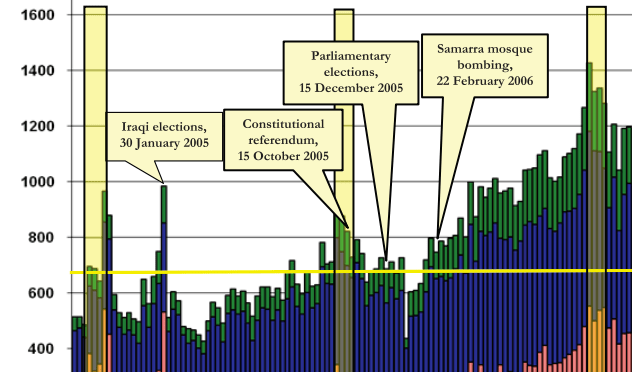
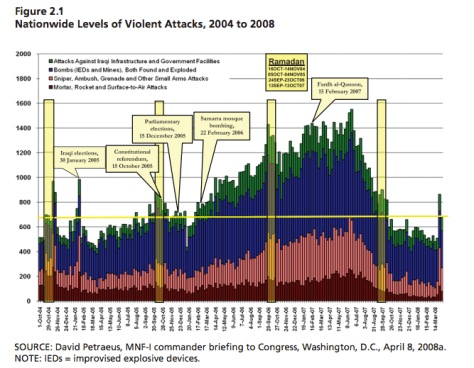
Just found this, and wanted to get it up here, as its important for overall context.  This is the chart Gen David Petreaus showed during his Congressional testimony in April of 2008, as he reported on the progress of the ‘surge’ which began in 2007.  It shows the levels of violent attacks over time, throughout Iraq.

Note that in spring/summer of 2005, corresponding with 3/2’s deployment to Al-Qaim, attacks were rising towards a peak during Ramadan in September.
Petreaus chart

I found this in a RAND study, Foundations of the Islamic State: Management, Money and Terror in Iraq 2005-2010.

Who was the enemy? part2

Update (18jun18): Just found an interesting reference, mentioning several insurgent groups allegedly fighting in the Al-Qaim area in early 2005.  This from a “resistance” propaganda blog, and the whole piece is clearly very biased and inaccurate.  Much of it is just outright lies, but in one part several groups are mentioned.  Some are known (Ansar Al-Sunna, 1920s Brigades) but I’ve never heard of most of them:

Tuesday April 12: All involved Resistance groups (Jaish Ansar Al-Sinna, Mohammed’s First Army, Qaida Jihad in Raqfidain, Legions of the twenties Revolution, Legions of Al-Nasir Salah Al-Din, Abu Bakir Salafi Legions, Rahman Salafi Legions, and the Islamic Anger Legions) issued a joint statement giving the Americans 12 hours to withdraw from the perimeter of Al-Qaim to allow food and water to flow in to the civilians. Otherwise, a spike in attacks throughout Iraq will follow. In a seperate statement, an unknown group, calling itself Legions for Unifying Iraq has threatend to attack many targets, including churches, in response for prominently manifesting the Cross on American tanks.
(See the article here)

Update: Just finished a draft chapter on “The Enemy”.  Download it here

(See part 1 for a meandering attempt at an intro to this key question…)

As in any insurgency, the most frustrating aspect of the war in Iraq was always figuring out who the enemy was.  Right from the start, Saddam’s fedayeen fought the coalition in civilian garb and vehicles, and Iraqi soldiers and commanders quickly shed their uniforms but kept their weapons.  But there was also seriously muddled thinking at the top echelons of government and military command about how to characterize the enemy.  Early in the war, the Bush administration consistently used the terms ‘dead-enders’ or ‘former regime elements’ to describe the enemy.  All during 2003 and 2004, openly acknowledging an insurgency essentially meant admitting that Iraq would be a long and costly war, which was a political liability. Secretary of Defense Donald Rumsfeld famously and stubbornly refused to say there was an insurgency in Iraq until mid-2005 when the semantic charade became too painful.

This obfuscation trickled down through the military chain of command and into the field.  As 2004 turned into 2005, commanders, military intelligence officers, and public affairs spokesmen typically referred to the enemy simply as ‘anti-iraqi-forces’ (AIF), which crudely lumped together the various strains of the insurgency into a convenient, but conceptually erroneous acronym.  

For anyone deployed to Iraq in 2005, however, two things were crystal clear.  First, whatever approved ‘acronym-of-the-month’ was being used to describe them, there were definitely lots of armed insurgents.  Second, the insurgents were anything but monolithic. There were many groups and fluidly-organized elements that were fighting against Coalition troops, with a variety of motivations.  As many analysts have noted, the insurgency was never an organized, unified hierarchy but was a viral, highly adaptable and decentralized network.    

One common way that the Coalition tried to build a slightly more granular understanding of the enemy was to subdivide the ‘Anti-Iraqi-Forces’ label into major sub-categories.  In some headquarters, particularly among the Marines in Anbar and including RCT2 in early 2005, the insurgency was conceptually divided into three parts: criminal gangs, former regime elements (FRE) and foreign fighters (FF).  But in reality, these labels were still too simplistic and misleading to be of much use in understanding the enemy or formulating an effective counter-insurgency plan.  

The terms ‘criminal gangs’ or ‘criminal elements’ were very loose catchalls, which encompassed traditional cross-border smugglers, corrupt police or border guards, IED emplacement cells and guns-for-hire which offered services to the highest bidder, as well as tribal ‘security’ groups or militias.  While the Marines in 2005 (and the coalition overall) were still grappling with the question of how to relate to the tribes of western Anbar, most tribal forces were simply tagged as criminals.  

‘Former regime elements’ was probably the most meaningless of the labels, since Saddam’s regime had been so pervasive and intrusive that almost every male of substance in Anbar had some level of connection to the Ba’ath party apparatus, various government-controlled enterprises, the omnipresent security services or the military.  Bundling an individual or group into the ‘FRE’ category was usually a shorthand way for analysts to portray them as less-religiously motivated, and less affiliated with Al-Qaida and the transnational jihadist movement.  Plus, for field-grade and general officers in particular, using the term avoided the potentially loaded word ‘insurgents’ and possible heat from superiors.  Thus, many figures and factions in the insurgency in Anbar were initially thought of as former cronies of Saddam, when the reality was far more nuanced.  For decades, Anbaris had pushed back against government control from Baghdad, sometimes violently.  Saddam had seen the fractious sheikhs and tribal leaders in Anbar not as his cronies, but as rivals that needed to be neutralized or co-opted.  

The term ‘foreign fighters’ or ‘foreign fighter network’ was the most useful of the three labels, but still managed to dodge precisely defining the enemy.  While non-Iraqi fighters did sometimes end up with other groups, the vast majority were recruited, transported and deployed (often as suicide bombers) by the network led by Abu Musab al-Zarqawi, the Jordanian jihadist who became the most wanted man in Iraq. Essentially, when the Marines of RCT2 and the 3rd Battalion referred to ‘foreign fighters’ they were talking about the group that came to be known as ‘Al-Qaida in Iraq’ or usually just ‘AQI’.  And by spring of 2005, the main enemy in the 3/2’s battlespace was AQI.

However, the key point to understand about the insurgency in Iraq was its highly interwoven, amorphous character. Most of the fighters in western Anbar who were laying IEDs, sniping at troops or firing mortars at a coalition base, could on any given day fit at least two of the above labels and possibly all three.  For example; the same fighter or small cell might be simultaneously associated with a so-called ‘nationalist’ insurgent group, and part of their tribe’s militia which was deeply involved in smuggling or other black-market activities.  That would put them in both the ‘criminal gangs’ and the FRE categories. Additionally, if the smuggling involved bringing jihadists across the border from Syria, they could be labeled as part of the ‘foreign fighter network’.  

To further complicate things, shifting loyalties from one group to another was common, and insurgent groups often splintered, taking on different names, or recombining under some new name.  Moreover, certain insurgent cells were blatantly mercenary, treating violence as an opportunity for income.  Usually, these would be highly proficient in some particular area, such as bomb-making or firing mortars or rockets.  

In short, attempts to conceptually divide Iraq’s insurgency into discrete, neatly-packaged categories or groups was always too simplistic.  Later in the war, the US military developed the expertise and methodologies to understand and portray the insurgency in more detail, which helped immensely in 2006 and 2007 as the coalition began to wage a successful counterinsurgency campaign.  

But in the spring and summer of 2005, leaders and intelligence personnel in 3/2 were still trying to answer the essential questions; Who is the enemy? Where are they? How do we defeat them?  

While AQI was the most prevalent enemy in the Al-Qaim district, there were identifiable non-jihadist insurgent groups in AO Denver that operated under their own banner, and would issue communiques or threats and claim credit for attacks. At times they might cooperate with each other, but remained separate entities in that time period. Almost all their members were Arab Sunnis, as was the populace of western Anbar:

  • 1920 Bde logoThe ‘1920s Revolutionary Brigades’ most easily fit the characterization of an ‘Iraqi nationalist’ group, and many of its members were former military personnel. The name referred to the 1920 Iraqi uprising against the British colonial occupation, and the group formed soon after the US-led invasion in 2003.  Their rhetoric was anti-colonial, anti-occupation, anti-coalition, their stated purpose to rid Iraq of all foreign troops (including Iranian-controlled militias), and revert to an Arab, Sunni-dominated country.  The main distinction between the 1920s Brigades and most other groups in Anbar was the lack of emphasis on jihad and establishing an Islamic ‘caliphate’.  This translated into their tactics and how they fought.  Fighters in the 1920s Brigades were far more likely to take on US troops using direct fire and IEDs, and much less likely to use suicide bombings. In general, they avoided hurting Iraqi civilians and in some instances exhibited a rough-hewn ‘code of conduct’ on the battlefield, such as not beheading captives or defiling bodies. Their main operating areas in western Anbar, however, were mostly north of the Euphrates, between Rawah and Hit, which was further east and outside of 3/2’s battlespace in the Al-Qaim district. 
  • IAI logoThe Islamic Army in Iraq (IAI), or Jaysh al-Islami (JAI) was another Iraqi nationalist-oriented group that sprang up soon after 2003. With some estimates crediting IAI with 10,000 members, it was probably the largest Sunni insurgent group in the early part of the war.  Like the 1920s Brigades, IAI aimed at ejecting all foreign forces from Iraq and counted many former military in its ranks.  But as its name implies, IAI’s agenda was more Islamist in nature and up through 2005 cooperated closely with Al-Qaida in Iraq (AQI) and its predecessor groups.  Sheikh Ahmed al-Dabash, one of IAI’s founders, claimed to be “like a brother” to Zarqawi.  By 2006, however, IAI was denouncing Zarqawi’s bloody attacks on fellow Iraqis and began openly fighting against AQI.  In Anbar, IAI mainly operated in and around Fallujah and Ramadi, although some of the tribal fighters that 3/2 encountered further west may have been affiliated with IAI.
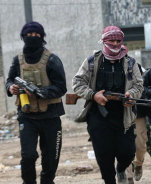
  • Iraqi tribal fighters.pngVarious tribal groups (an admittedly imprecise term) also fought against 3/2 and other coalition forces in far western Anbar.  These could be very localized, operating only in a particular village or district, under direction of a minor sheikh. In 2003 and 2004, most of these groups and cells were fighting against US troops, first against the Army’s 3rd Cav and then the Marines, and saw Zarqawi and his foreign fighters as allies against the occupiers. In fact, distinguishing between foreign fighters and local insurgents could be difficult. Clearly, 3/2 Marines were often fighting both foreign and local fighters in the same engagement.  By 2005, however, some of these tribal forces were rebelling against AQI. The most notable of these groups was the “Hamza Brigade”, an armed militia formed by the Albu Mahal tribe in and around Husaybah.