Category Archives: 3/2 Marines

Penny’s Shootout

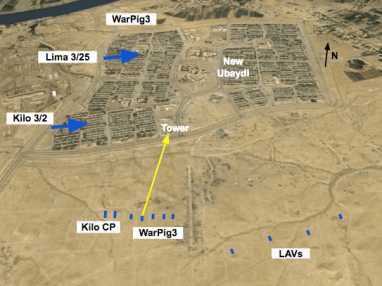
On Day 1 of Operation Matador, during the assault on New Ubaydi, the 3rd Platoon of 3/2’s Weapons Company (otherwise known as WarPig 3) took up support-by-fire positions outside the town.  With their up-armored HumVees, which they called gun-trucks, they provided heavy firepower with turret-mounted .50 cal machine-guns and Mk19 40mm grenade launchers.

Jonathan Penland

Lieutenant Gabe Diana’s command vehicle and one gun-truck section were on the north side of New Ubaydi, while a second section was south of town about 500 meters out.  Cpl Jonathan Penland was a Mk19 gunner on one of the trucks.  Like most of 3/2’s marines that day, this was his first taste of combat.  He’s shared the following account with me (used with permission):

SSgt Daniel Garcia was my Section Leader and our vehicle commander (VC).  Robert Branch was driving. In the back were McGrath our comms guy, and McIntyre.  I was up top on the Mk19. It was a brand new truck, hardly a scratch on it when we started out that day. 

As we pulled up in the support by fire position, SSgt Vargas’ truck was on our left. Eric Haight was their .50 cal gunner.  Just as we stopped, an RPG came whooshing by, right between our vehicles. Haight and I looked at each other. I could see his eyes.  And it was like I could see him say “Holy shit! That was a rocket!” Then we both looked forward, and he opened up with his Ma Deuce.  

Branch talked me on to a plume of smoke in an alley.  I opened up on that spot, but he said “No, they’re running away”.  I cranked up my elevation for more distance.
Pennys fight

I had a malfunction. The weapon was jammed.  I started yanking back on the charging handles, over and over.  But I still couldn’t clear it. At the same time, our truck was getting lit up.  Here I was, just 21 years old, and didn’t really realize or care how close those rounds were.  I was just focused on getting my gun back in action.

Finally I put my feet all the way up on the turret to get leverage, and got it unjammed.  But by then the incoming was so intense I could hardly reach out to reload. Every time I’d reach my arm out, more MG rounds would hit. Obviously somebody was watching me, trying to take me out.  

Then Garcia started yelling, ‘Penny get down! Penny get down!’  He grabbed me by the belt and yanked me down. Almost pulled my pants down.  Just as he did, there was a hugh ‘clang!’ My ears rang and I felt a burning on my face.  A 7.62mm round had hit right where I was, right on the traverse mechanism, and fragments had stung my face.  It left a huge mark, as big as my hand, on the metal.

So then Branch yells at me, ‘just turn your turret around!’  And I started traversing the turret to the rear to reload, then cranked back around to fire.  I did this multiple times. When I’d turn back, I could hear enemy fire hitting the backside armor, making a hell of a racket.  It was kinda like being inside a bell.

Our Platoon Sergeant, SSgt Vargas, started calling over the radio.  “Vehicle 5, shoot the middle window of the tower!”. So I fired 6 rounds off, and they overshot and hit near a mosque.  Vargas calls, “No, hit the tower!” So I fire about 6 more, ka-chunk! ka-chunk! ka-chunk!. It was like an Atari game. I could see the rounds arcing out, and they splashed directly on the middle window.  I unleash again, and pegged it again. All incoming from there stopped, and right after that is when the helos came in and hit it with rockets and a gun run. I think they were using my impacts to spot the target.   

When that day was over, our truck’s nice paint job was a mess, with dents and gauges all over it where we’d been hit.  And I figure I owe my life to Daniel Garcia. If he hadn’t pulled me down, I don’t know what that slug would have done.  Most likely it would have hit me in the gut, and I’d have bled out on the floor. By the way, that’s how I got my nickname, from that firefight.  After that, everybody started calling me “Penny” and it stuck.


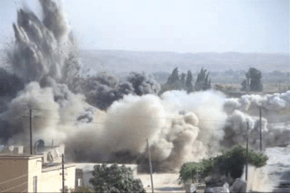
Here’s a short clip, showing the fire station tower getting attacked by Cobra helicopter gunships.  The vehicle in the foreground is a LAV-25, situated to the east (right) of where Penny’s gun-truck was.

“Heart for the Fight”, by Brian Stann


Screen Shot 2018-06-21 at 7.49.12 PM
Click to see the listing at Amazon.com

As I write about Operation Matador, I find myself referring frequently to Brian Stann’s excellent autobiography, “Heart for the Fight“.

Stann was a 2nd Lt during the 2005 deployment, and a Platoon Commander in the Weapons Company (callsign “WarPig”).  Stann’s platoon, WarPig2, set up a blocking position on Day 1 of Matador and spent  several days in an intense 360-degree firefight at the Golden Gate bridge, along with WarPig1 under 1stLt Bryan Leahy.

Stann was awarded the Silver Star for that action, and later became a championship mixed-martial-arts (MMA) fighter.  The book covers his life before and after the Marines, including his MMA career.  It’s very readable, with lots of action, and I recommend it.  The book has a detailed, 60-page description of the fight at the bridge, and WarPig2’s running gun battles back and forth to Camp Al-Qaim.

There is no need for me to duplicate Stann’s excellent first-hand account, but I will try to capture other perspectives from WarPig veterans who were there during the multi-day fight.  In some ways, the action at the bridge was the real crux of the operation, and may well have involved Zarqawi’s close lieutenants, body-guards, possibly even the arch-terrorist himself.


We Happy Few

CroftandScott
Cpl Michael Croft (right) with Scott Hauslyak (left) after Operation Matador, May 2005.  Scott was wounded during the operation, when a suicide bomber struck his vehicle.

Recently I had a chat session with Michael Croft, who was a forward observer (FO) with 3/2’s Weapons Company, but was attached to the Fire Support Team in Kilo Company for most of the deployment.  He was involved in most of the major operations, and saw a lot of unpleasant stuff.  He mentioned that he thought the book should have more reflections of the extremely close bonds that the Marines forged with each other, and that is great feedback.  I can see that is something I can work on, to give more depth and meaning to the book.

When I asked Michael to describe those bonds, here’s what he shared.  I’m posting it here (with his permission), to hopefully generate some more thoughts from other 3/2 Marines…  Also, I have a specific question about the “We Happy Few” phrase (from the famous speech by Henry V in Shakespeare’s play).  Was it a common phrase in 3/2?  How did it start?

Anyway, here’s what Michael Croft says about the bonds of brotherhood:

When we would go through something like seeing those kids dead or the AAV hitting that mine and catching on fire and Marines burning to death, it would really shake us. I personally remember after seeing those kids dead, I stood up on the balcony of that house and just stared out in the distance for a while feeling empty inside. We didn’t have anybody but each other to lean on in those moments and the fight didn’t stop so that we could feel upset about what had happened so it was the brothers beside us that would pull us out of those moments of shock and remind us that they needed us to push through so we could do our jobs in order to make sure the next time we saw bodies on the floor it wasnt one of our own.

I remember after a major tragedy would happen, 1st Sgt. Gregory would always notice who was feeling it the most and would make it a point to make sure they were OK. Knowing that in the midst of battle and seeing the horrifying stuff we would see, that the guys beside us had our back and were not judging us even if we had tears running down our face created a type of bond I have yet to achieve with anybody else since, and those bonds are still just as strong today.  Even though physical distance may separate us now, I would still jump on a grenade for any of my brothers from back then.

I remember a quote that went around a lot during that deployment was “We few, we happy few”, and it was perfect for the type of brotherhood that is created from the type of battles we fought in.  It’s how you get a young kid to be the first to go into a house where he knows insurgents are waiting for him.  That bond makes him want to sacrifice himself so that the other men behind him live.  –Michael Croft, chat session with author

I’d love to hear more thoughts about this from other Marines.  Please contact me if you have something to add.

–Ajax

Update (20jun18):  I did get a response about the Shakespeare quote,
“Comment: “We few, we happy few.” A quote that would stick with me for a very long time. A brotherhood that will never be broken. We are indestructible. And yet so vulnerable… We were fighting ghosts. And sometimes that still haunts me.”

References for Operation Matador

Matador raftThe Bridge

M1977 HEMTT Common Bridge Transporter (CBT)


SOF Raids vic Ramana 

“We started working closely with some of the coalition force assets built out of friendships and relationships from the past… They did a raid north of the river into the Rumana area about three weeks ago, or about two weeks preceding Operation Matador…

About a week later, the forces — again, [other] coalition forces — did a vehicle interdiction north of the river based on some sensitive intelligence.  They got into quite a shoot-’em-out. They had a little pick-’em-up truck that had about 14 people in it. So they came and killed all of them — two wounded prisoners came off, including a little girl that was reported out in public.  But in there was a mash of foreign fighters.  Sudanese, Saudi, many guys from Syria. Some of them had documentation.  Some of them had suicide notes on them. So we knew there were foreign fighters up north of the river.”
–Col Davis, Awakening, Vol III

U.S. Says Zarqawi Letter Recovered, NBC, 3may05
“Monday’s battle occurred after coalition forces searching an area of suspected insurgents followed a truck to an isolated tent and shed east of Qaim, the U.S. military said in a statement…  There, men from the truck and from inside the tent and shed loaded materials onto the vehicle. the military said. When it began to drive off, coalition forces stopped the truck, and the suspected insurgents — armed with assault rifles and hand grenades — opened fire, the statement said… 6-year-old girl received injuries to her head and one leg, the military said… Searching the site of the battle, coalition forces found false identification cards, foreign currency and other evidence of direct ties with Zarqawi’s terrorist group and other insurgent groups based outside Iraq, the military said.”

“around that time, probably even before then, there were some special operations raids going on north of the river. I only knew about that, because we’d have to clear
airspace for them. They obviously knew there were some folks up there and were going
after them, but it was very selective.” –LtCol Mundy, Awakening, Vol IIIA


Red-on-red

Rebels Said to Be Battling One Another, LA Times, 8may05

Lt. Ronnie Choe, the camp’s intelligence officer, said many area residents who initially fought alongside insurgents trickling across the border have since become disillusioned with the militants. Whether this is wishful thinking on the Marines’ part or reality cannot be determined; it is unsafe to venture into the town for interviews. “Tensions in Husaybah arose from foreign fighters coming here and staying here. Even the imams have been intimidated by the mujahedin,” Choe said, using the local term for the rebels.

Last month, he said, insurgents kidnapped a cleric who had delivered a Friday sermon asking foreign fighters to stop attacking Americans from Husaybah because it put townspeople at risk when Marines returned fire. Choe also described how foreign fighters had hijacked the weekly sermons. “You’ll hear one voice giving the sermon, and then someone else will get on,” he said.

Choe noted that calls on the camp’s tip line were increasing and said those contacts were his best source of intelligence.  Two weeks ago, troops raided a house in Husaybah and found a weapons cache. The family readily acknowledged that insurgents had hidden contraband in their home, Diorio said.  “They said, ‘Yeah, they came and put weapons here. And before they left they shot my son.’ ”


Col Davis Interview in The Awakening, Vol III:

The operation was briefed throughout the chain of command and at some point it appears that information was leaked. I say this because, just before—before being relative, five, six days before—we launched this operation, we found red-on-red fighting breaking out all over the south side of Al Qaim. We had fights between Husaybah and Karabilah. We had fights between Sadah and Ush and between Old and New Ubaydi right across that Upper Peninsula. We didn’t understand it. We appreciated it, but we didn’t understand it. 

Everywhere and nowhere:

I was trying to create the illusion of a greater force structure by showing up everywhere but nowhere, in order to not be predictable. I was beginning to understand the threat, having dealt with these guys before, so I understood how they were looking at us. Philosophically, we were just trying to out-guerilla the guerilla. I needed to be everywhere and nowhere; I was setting a pattern, but not setting a pattern. –Col Davis, Awakening, Vol III


Al-Qaim I, Al Qaim Hospital: Tragedy Beyond Description
Sabah Ali, Brussels Tribunal

(Note: This is a series of very biased articles, probably with many inaccuracies, accusing US troops of many civilian deaths and malicious intent.  It evidently conflates red-on-red firefights and insurgent violence with Operation Matador and US operations. In so doing, however, it provides some insight on the fight between local tribal militia and AQI that erupted on 2 May 05.  The quote below is an example:

Aysha, a young widow covered with black, who works in the hospital, was there on May 2, 2005.  “It was noon; the shooting began after a dead body was brought here. The hospital was surrounded; the place was full of armed men. I told them that my 3 children are alone in the house and that I got to leave. I had to go from corner to corner, under the fire. I found the fighters inside my house. They told me to stay, I could not. I decided to take the children to my father in law’s house across the street. A shell was dropped at the door; I decided to go no matter what. My husband’s family went out to see, another shell was dropped on them, 5 children were killed, and 4 women injured, one of them lost one of her eyes. I left Al-Qaim and went to Ebeidi; the fighting was heavier, so I went to a village called Al-Khaseem until the fighting was over. Many people are telling me to leave Al-Qaim, but where am I to go, I work here”.

Governor of Anbar kidnapped, 10 May 05

Farhan w Mundy1

Part of the backdrop to Operation Matador (8-14 May 05) was the kidnapping of the provincial governor by insurgents on 10 May.  This was also part of the wave of violence sweeping over all of western Anbar province at the time.  The kidnappers (probably AQI) explicitly said they took the action to force US forces out of the Al-Qaim area.  Like so many others, this story has a tragic ending, with Governor Nawaf Farhan eventually being killed in a firefight several weeks later.

It took me a while to connect the dots here, but recently was able to tie several things together.  Farhan’s kidnapping and death makes much more sense to me now, and helps fill out the overall narrative.  The main piece that fell into place was my discovery that he had been the Mayor of Al-Qaim, the same one LtCol Mundy and other 3/2 Marines met with on 15 March (the ides of March, BTW) at the beginning of the tour.
3/2’s CO meets with Al Qa’im mayormarines.mil, 15mar05

His full name was Raja Nawaf Farhan al-Mahalawi, signifying he was part of the Albu Mahal tribe (for some reason, the Marine.mil article above calls him Raja Nuwaf Fahran Al-Sharhi).  According to an Al-Jazeera news item:

[Farhan] Al-Mahalawi only recently became governor after tribal leaders forced out his predecessor Faisal Raikan al-Gut al-Nimrawi, who narrowly escaped a roadside bombing in February.  Al-Mahalawi, who is originally from al-Qaim, served as mayor of the town under Saddam Hussein.

Weeks later, the Governor met an untimely end, ironically just as US troops had stumbled upon the location where his captors were holding him.  Here’s an excerpt from his Wikipedia entry:

On 29 May, a US Army unit on patrol near Rawah came under RPG and automatic rifle fire from insurgents in a farmhouse.  They returned fire, killing 4 of the fighters and wounding 3 others.  Farhan’s body was then found inside the house. The body was found blindfolded and chained to a gas cylinder, and had suffered from a blow to the head.  Mahalawi hadn’t been shot, but had instead seemingly been killed by a falling piece of rubble during the firefight.  Of the four fighters killed by the US troops during the firefight, 2 were from Syria, 1 from Algeria, and 1 from Jordan. Of the three injured and captured, 2 were Saudis, and 1 was a Moroccan.

And here are several more press articles about this whole episode:

Governor of Iraqi province seized, Al-Jazeera, 11may05
Abducted Iraq governor found dead, BBC, 31may05
Governor of Anbar Province Killed, Fox News, 31may05
Body of kidnapped Iraq governor is found, NY Times, 1jun05
Anbar leader found dead after assault, Chicago Tribune, 1jun05
Kidnapped Iraqi governor is found dead after clash, Boston Globe, 1jun05

Retrans: Scorpions, sunsets and survival


two guys in bunker
(Matt Gundlach photo)

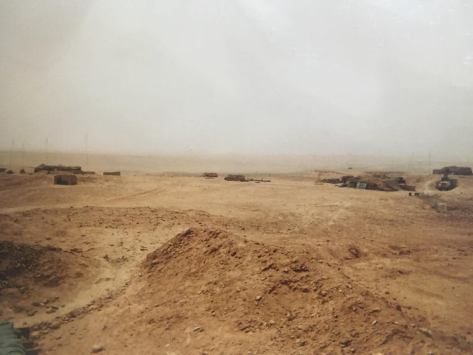
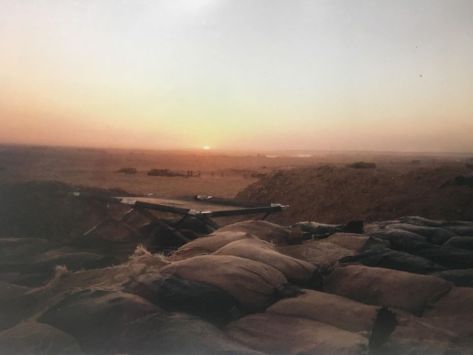
The desert outpost known as “Retrans”, or as it was officially called, Battle Position Khe Sahn, was one of the most isolated, desolated posts in Iraq.  David Pape, a mortarman with Kilo Co. described it like this: It sucked!! The enemy hit us constantly…  The all-MRE diet, sleeping in bunkers, and the godawful heat. But there were good times too.  We dropped hundreds of mortar rounds, and I saw the most beautiful sunsets and stars I’ve ever seen.

I’ve just finished the draft chapter on Retrans. Download it here  Thanks to the Marines who talked and chatted with me about it, and shared their photos. Enjoy…

–Ajax

Operation Matador: Report from the Front

Matador crossing riverThis popped up on Facebook today.  It’s letter from LtCol Tim Mundy, 3/2 Battalion Commander, to families and other members of the community back home…

Operation MATADOR report from the front (19may05)
From LtCol Mundy in Al Qaim:

Friends and families, I think it was Mark Twain who once said, “Never put off till tomorrow what you can do the day after tomorrow.” Thankfully Mr. Twain is not running this Task Force, chasing the enemy, or keeping you updated of all that’s going on. From the news reports of last week, many of you are aware of what happened during Operation MATADOR and now know why you did not receive that Mother’s Day call from your son or husband–they were out showing the world why there is no better friend and no worse enemy than a United States Marine. As their Commanding Officer, I wanted to personally share with you why I’m so intensely proud of YOUR Marines and Sailors of Task Force 3/2.

Operation MATADOR was a great success. It was my privilege to lead the men of Task Force 3/2 into enemy territory to conduct combat operations against anti-coalition forces situated along, and north of, the Euphrates River. During the weeklong operation, I saw our Marines and Sailors conduct themselves with the height of honor, depth of courage, and breadth of commitment indicative of the world’s finest warriors. I couldn’t be prouder of these men and all they accomplished. I know you must feel the same.

Let me explain why this operation was necessary:

The war on the terrorists came late to Al Qa’im. This area is isolated by distance and cultural idiosyncrasies from central Iraq . For centuries, this has been a corrupt trade route area on the Euphrates. For decades, not even Saddam Hussein truly controlled the crime, corruption, and disloyalties. This abnormal, different area became the natural safe haven for some foreign fighters. They transit the area and use it as a staging ground for insurgency and terrorist actions in other areas of the country. We didn’t have a good ability to cross to the north side of the Euphrates and stay for longer than a raid. In the last six to eight months, the foreign fighter presence and activity grew in the area north of the river. Task Force 3/2 is situated in the midst of this volatile area, and believe me, none of your sons, brothers, husbands and/or fathers shrink from the challenges we find because of it! There is a dangerous enemy here, but your Marines and Sailors know their jobs, and they do them well, so we can handle the threats.

Our RCT headquarters planned offensive operations under the name MATADOR to clear the area of insurgents and to prove to the foreign fighters that they had no safe haven north of the river. Your men proved just that! We were joined in the fight by several units: Bravo Company, 2nd Light Armored Reconnaissance (LAR) Battalion and Lima Company, 3rd Battalion 25 th Marines. While we have always been superior in individual fights in the area, we increased the strength of the Task Force to clear through the strongholds in the north and maintain security in the south.

Our two rifle companies, Kilo Company 3/2 and Lima Company 3/25, reinforced by one Warpig mobile platoon fought bravely with entrenched insurgents in the towns of Ubaydi and Ramana. Their tenacity to take the fight to the enemy resulted in a significant number of enemy kills and captures, thereby hampering enemy ability to move at will in this region.

Bravo Company, 2D LAR and Alpha Company, 4th AAV provided protection on our flanks, much need flexibility in the field of battle, as well as the ability to quickly move large numbers of our men across enemy territory. The men of India provided a blocking position in support of the operation, and also continued their fight around Camp Gannon , while the Warpigs of Weapons Company also manned the key blocking position as well as provided effective fire support during the entire operation.

Needless to say, there were many moments of fierce fighting. Many Marines demonstrated heroism and accomplished extraordinary feats. I don’t need to provide details of firefights — trust me when I say your men performed as I expect them to perform when they carry the title of United States Marine. They were awesome! As we continue our mission in this region, we humbly ask for your prayers and thank you for the faithful support you’ve given this Task Force. We could not do what we do without all of you.

Our thoughts are also with the friends and families of the 9 Marines who died protecting their brothers in arms. I held a memorial service in their honor Sunday evening, 15 May in the orange light of a setting sun. These are the names of our fallen comrades:

SSgt Anthony L. Goodwin, RCT-2, attached to Lima Company, 3rd Battalion 25th Marines
SSgt Kendall H. Ivy II, RCT-2, attached to Lima Company, 3rd Battalion 25th Marines
Cpl Dustin A. Derga, Lima Company, 3rd Battalion 25th Marines
LCpl Lawrence R. Phillippon, Kilo Company, 3rd Battalion 2nd Marines
LCpl Wesley G. Davids, Lima Company, 3rd Battalion 25th Marines
LCpl Nicholas B. Erdy, Lima Company, 3rd Battalion 25th Marines
LCpl Jonathan W. Grant, Lima Company, 3rd Battalion 25th Marines
LCpl Jordan L. Grez, 4th Combat Engineer BN, attached to Lima Company, 3/25 BN
PFC Christopher R. Dixon, Lima Company, 3rd Battalion 25th Marines

There really is no greater love than he who lays his life down for his friends. They lived as warriors, died heroes, and will forever be honored. May God bless their memories and comfort their families. We also had wounded Marines who will require, in some cases, lengthy recovery times. Keep them and their families in your prayers as well, as we wish for a full recovery and return to 3/2.

I’ve said this once before and it bears repeating: Mail and care packages from home continue to be a weekly highlight for our men. Anything you send from home reminds us of your love and support and really boosts morale. The generosity of all who’ve given does not go unnoticed.

LtCol Tim Mundy

A hard day

The 8th of May is a hard day for the families of three Marines who lost their lives during Operation Matador, in New Ubaydi, in 2005.  It was the first day of the operation and a Sunday. And that Sunday was Mother’s Day.

Philippon w helmet

It was also a hard day for many of the Marines who were there that day, fighting alongside their brothers in strange and dangerous place.  Some of them still struggle with their memories of that day.

LCpl Lawrence (Larry) Philippon, from Kilo Company, 2nd Plt, was killed during house-to-house fighting as Kilo Company cleared New Ubaydi.  He was an exemplary Marine, a leader in his platoon, who had pushed to get combat duty.

Philippon in bunker.png

According to an article in his hometown newspaper, Larry was a star athlete in high school, then went to Central Connecticut University for a time.  But in 2003 “He came home one day and said he was going to join the Marines.”  He was selected for the Marine color guard, and served with distinction there, but persistently requested duty with a front-line infantry unit. He told his parents, “I didn’t sign up to be a pretty boy”.

I know this is a tough time for the Philippon family, and my heart goes out to them. I’ve had some initial contact with them, and will soon be writing more about that day and Operation Matador overall.  It is a daunting task that I do not take lightly.

SSgt Goodwin


Two other Marines also lost their lives that day, from the 3/25, a Marine Reserve unit from Ohio.  SSgt Anthony Goodwin, on his third deployment to Iraq, and one of the key NCOs in his unit.  This is an excellent video tribute about him.

Cpl Derga.png

Cpl Dustin Derga, was a firefighter back home and another young man who pursued a calling he felt to be a Marine, through the reserves.  Here’s a touching tribute, written by his father.

–Ajax


More Retrans stories

Several Marines have reached me tonight with more info about their time at the outpost known as Retrans (it was set up as a radio retransmission station).  See more here.  I’m working on a short chapter about it, and asked for stories, memories and photos, and they started rolling in.  Thanks guys!

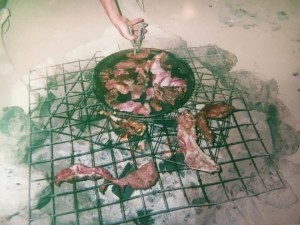
David Pape sent me the story of the great 4th of July sheep BBQ, and its posted here [slightly edited] with his permission:

I can pretty much guarantee that there was not a single marine in 3/2 who spent more time at Retrans then I did.  81’s [mortar crews] would’ve been the closest but even they got relieved more then I did… It sucked up there man!  But we dropped hundreds of rounds from there, ran illum [illumination] missions for sniper attachments. And had serious Spades tournaments to kill time!  It was the MRE diet, sleeping in bunkers, and the heat!  But that is also where I’ve seen the most beautiful sunsets and stars I have ever seen!!

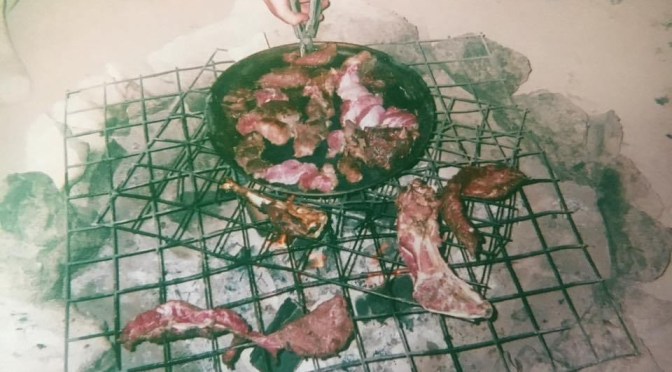
And [then there are the] stories about the sheep I cleaned and cooked. One the first tour [at Retrans] and the second on the Fourth of July!!  The first trip out there I was eating an MRE at daylight and I look up and across the wadi there is a lone sheep. I asked SSgt Jeremy Martinez to let me shoot it and he wouldn’t let me.  So a sniper shot it, and me and Gayle drug it over and cleaned it. Then we cooked it on the bone.

Sheep on the grill
Sheep on the Barbie…

The week of the 4th I told everybody watch for the sheep herders and if they come let me know.  On the 3rd two kids had a herd down by the bridge. So 6 or 8 of us kicked out a little patrol.  A guy went high and set up overwatch with a SAW a few hundred back. We get down there and trade 20 American dollars and a case of MREs for two sheep. One didn’t want to leave the herd, so Montoya dropped it.  We finally got back and put the live one in the M-240 bunker overnight. It shit everywhere!!

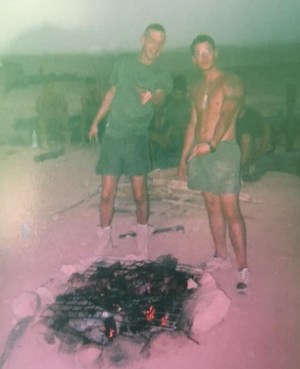
Next day we killed it. I showed John Parina how to gut it. Hung it on the front of a 7-ton [truck] on the spreader bar used for towing, skinned it out and quartered it.  They had a pan in the .50 cal bunker, and some Tony Cajun’s [seasoning].  I can’t remember where the grate came from. So me and Wheatley, a kid from the 81’s, cooked it and we all ate it. It came out pretty good actually. It was fresh meat, hoof-to-table… 


by the fire
David Pape (right) and buddies by the fire


We were Marines at war and it was rugged, and manly on our Independence Day.  It felt symbolic.  I don’t know, maybe we were all thinking what guys our age were doing back home, or what we would have been doing.  What we were actually doing was way more badass!!
–David Pape, Weapons Co, Chat session with author

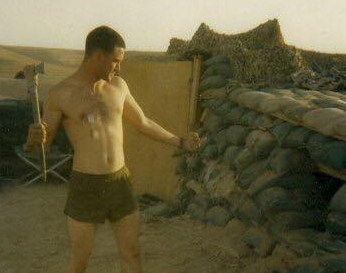
Here’s what Steve Gray remembers about Retrans (used with permission):

Retrans was playing monopoly till someone mortared you then shooting the hell out of them… There were so many IDF [indirect fire] attacks it was more common to have them then not… The fact that no one was killed there was incredible since it was almost daily contact…

Six-foot-long Chinese rockets, so many mortar attacks I couldn’t count, some small arms, a lot of monopoly, goat herder’s food, mortar attacks. It was always a boring week or 2 on rotation though. Even if everyone got some trigger time.

Steve Gray w hatchet
Steve Gray doing home improvement on a bunker at Retrans

–Steve Gray, Chat session with author


And Ian Katner sent me several photos of the bunkers, and surroundings, showing the, umm… living conditions:

5-smoking
Ian Katner smoking, Jones is behind him in the dark, Riddle to the left, and Sciotti to the far left.


1-from240
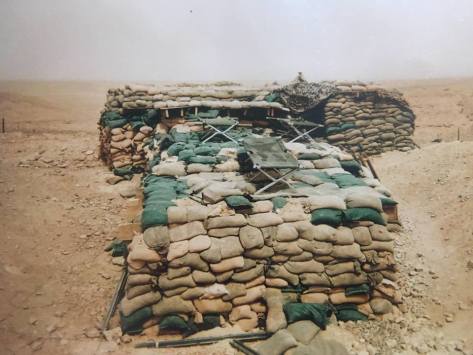
Positions were kind of in a triangle.  50 cal bunker north, MK19  bunker SW, M240 bunker SE.  This shows other bunkers from M240 bunker.
7-mortarteam
The mortar section with sunset in background.
2-topbunker
Top bunker housed machineguns, bottom bunker was sleeping quarters.


4-sleepingqtrs
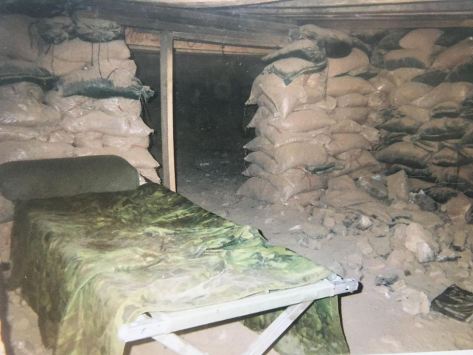
Sleeping quarters


3-viewinside
View from inside, with the cooking pit


8-abovecooking
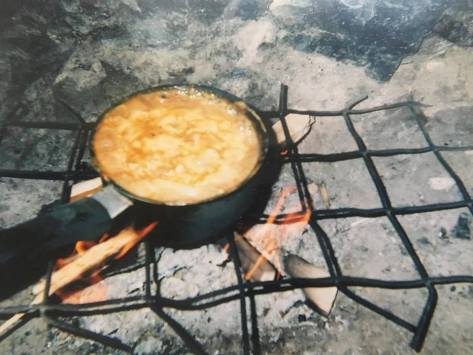
Above the cooking pit
9-cooking
Cooking multiple MRE’s in one pot.
10-Ian w MG
Katner with the 240 and Sciotti in the background with his foam hand.


Scout-Sniper operations


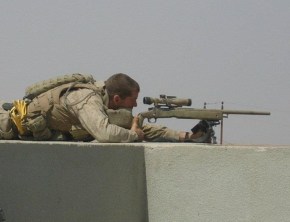
Burggraff on scope
Shane Burggraff, Reaper 2, on a rooftop somewhere near Al-Qaim (used with permission)

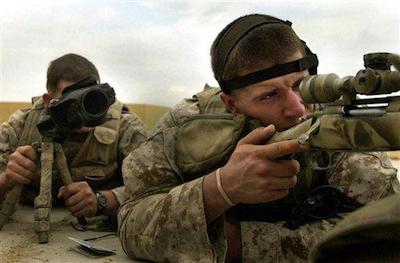
I’ve posted drafts of two chapters covering 3/2’s ScoutSniper Platoon (SSP).  The first is a short profile of the SSP, which went by the callsign “Reaper”.  The second describes several recon & surveillance operations in May and June of 2005.  It ends with a dramatic mission on 11 Jun 05, where two Reaper teams infiltrated into the insurgent-held city of Karabilah.  This mission was hugely successful, and helped prepare the battlespace for Operation Spear which came just a week later.

Reaper v1.4 (Platoon profile)

Target Softening v2.4

Note: Due to the nature of what ‘Target Softening’ covers, there are several places where names, quotes and photos are currently blanked out, waiting on specific permissions to be given.  I felt that would be prudent in this case.  Hopefully I will have those permissions soon.

Bomb on cityhouse?


Angel on My Shoulder.Really good article by Ed Marek, about Marines in Fallujah. Has an excellent section on snipers.  Not sure where to put this yet, so stashing it here…