Category Archives: 3/2 Marines

Happy 242nd Marines!

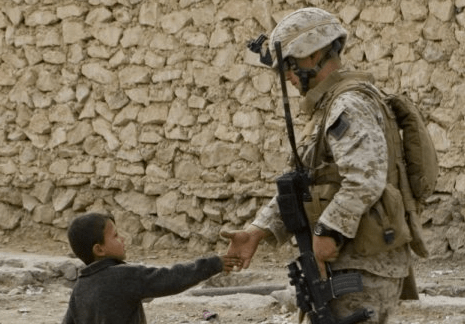
usmc-bday-2017At first I just posted the standard 2017 Birthday Message (below), but I like this one better. Not sure what unit it came from, but it shows Marines at a checkpoint in Iraq, probably around 2006 or so.  The bored grunt says “Let the insurgents know that Sierra Deuce is on Bugs and we’ll be here for an hour. We wanna play. Tell em to quit being pussies and cowards, and come out and shoot at us”…  Classic!


Understanding the Few Good Men

Col Cooling
Norman L. Cooling

Part of my research process has been an effort to better understand Marine Corps attitudes, organization, doctrine and “culture”.  Here’s a really good resource I found, written by two senior Marine officers, Norman L. Cooling and Roger B. Turner.  Their article is Understanding the Few Good Men: An Analysis of Marine Corps Service Culture.

Col Turner
Roger B. Turner

At the time Cooling was a Colonel and Turner was a LtCol.  Both reached Brigadier General, but I’m not sure about their current rank or status. I’m not sure where it was first published, but it looks like it was done for a military journal.  Anyway, I found it enlightening…

–Ajax


Who was the enemy? part2

Update (18jun18): Just found an interesting reference, mentioning several insurgent groups allegedly fighting in the Al-Qaim area in early 2005.  This from a “resistance” propaganda blog, and the whole piece is clearly very biased and inaccurate.  Much of it is just outright lies, but in one part several groups are mentioned.  Some are known (Ansar Al-Sunna, 1920s Brigades) but I’ve never heard of most of them:

Tuesday April 12: All involved Resistance groups (Jaish Ansar Al-Sinna, Mohammed’s First Army, Qaida Jihad in Raqfidain, Legions of the twenties Revolution, Legions of Al-Nasir Salah Al-Din, Abu Bakir Salafi Legions, Rahman Salafi Legions, and the Islamic Anger Legions) issued a joint statement giving the Americans 12 hours to withdraw from the perimeter of Al-Qaim to allow food and water to flow in to the civilians. Otherwise, a spike in attacks throughout Iraq will follow. In a seperate statement, an unknown group, calling itself Legions for Unifying Iraq has threatend to attack many targets, including churches, in response for prominently manifesting the Cross on American tanks.
(See the article here)

Update: Just finished a draft chapter on “The Enemy”.  Download it here

(See part 1 for a meandering attempt at an intro to this key question…)

As in any insurgency, the most frustrating aspect of the war in Iraq was always figuring out who the enemy was.  Right from the start, Saddam’s fedayeen fought the coalition in civilian garb and vehicles, and Iraqi soldiers and commanders quickly shed their uniforms but kept their weapons.  But there was also seriously muddled thinking at the top echelons of government and military command about how to characterize the enemy.  Early in the war, the Bush administration consistently used the terms ‘dead-enders’ or ‘former regime elements’ to describe the enemy.  All during 2003 and 2004, openly acknowledging an insurgency essentially meant admitting that Iraq would be a long and costly war, which was a political liability. Secretary of Defense Donald Rumsfeld famously and stubbornly refused to say there was an insurgency in Iraq until mid-2005 when the semantic charade became too painful.

This obfuscation trickled down through the military chain of command and into the field.  As 2004 turned into 2005, commanders, military intelligence officers, and public affairs spokesmen typically referred to the enemy simply as ‘anti-iraqi-forces’ (AIF), which crudely lumped together the various strains of the insurgency into a convenient, but conceptually erroneous acronym.  

For anyone deployed to Iraq in 2005, however, two things were crystal clear.  First, whatever approved ‘acronym-of-the-month’ was being used to describe them, there were definitely lots of armed insurgents.  Second, the insurgents were anything but monolithic. There were many groups and fluidly-organized elements that were fighting against Coalition troops, with a variety of motivations.  As many analysts have noted, the insurgency was never an organized, unified hierarchy but was a viral, highly adaptable and decentralized network.    

One common way that the Coalition tried to build a slightly more granular understanding of the enemy was to subdivide the ‘Anti-Iraqi-Forces’ label into major sub-categories.  In some headquarters, particularly among the Marines in Anbar and including RCT2 in early 2005, the insurgency was conceptually divided into three parts: criminal gangs, former regime elements (FRE) and foreign fighters (FF).  But in reality, these labels were still too simplistic and misleading to be of much use in understanding the enemy or formulating an effective counter-insurgency plan.  

The terms ‘criminal gangs’ or ‘criminal elements’ were very loose catchalls, which encompassed traditional cross-border smugglers, corrupt police or border guards, IED emplacement cells and guns-for-hire which offered services to the highest bidder, as well as tribal ‘security’ groups or militias.  While the Marines in 2005 (and the coalition overall) were still grappling with the question of how to relate to the tribes of western Anbar, most tribal forces were simply tagged as criminals.  

‘Former regime elements’ was probably the most meaningless of the labels, since Saddam’s regime had been so pervasive and intrusive that almost every male of substance in Anbar had some level of connection to the Ba’ath party apparatus, various government-controlled enterprises, the omnipresent security services or the military.  Bundling an individual or group into the ‘FRE’ category was usually a shorthand way for analysts to portray them as less-religiously motivated, and less affiliated with Al-Qaida and the transnational jihadist movement.  Plus, for field-grade and general officers in particular, using the term avoided the potentially loaded word ‘insurgents’ and possible heat from superiors.  Thus, many figures and factions in the insurgency in Anbar were initially thought of as former cronies of Saddam, when the reality was far more nuanced.  For decades, Anbaris had pushed back against government control from Baghdad, sometimes violently.  Saddam had seen the fractious sheikhs and tribal leaders in Anbar not as his cronies, but as rivals that needed to be neutralized or co-opted.  

The term ‘foreign fighters’ or ‘foreign fighter network’ was the most useful of the three labels, but still managed to dodge precisely defining the enemy.  While non-Iraqi fighters did sometimes end up with other groups, the vast majority were recruited, transported and deployed (often as suicide bombers) by the network led by Abu Musab al-Zarqawi, the Jordanian jihadist who became the most wanted man in Iraq. Essentially, when the Marines of RCT2 and the 3rd Battalion referred to ‘foreign fighters’ they were talking about the group that came to be known as ‘Al-Qaida in Iraq’ or usually just ‘AQI’.  And by spring of 2005, the main enemy in the 3/2’s battlespace was AQI.

However, the key point to understand about the insurgency in Iraq was its highly interwoven, amorphous character. Most of the fighters in western Anbar who were laying IEDs, sniping at troops or firing mortars at a coalition base, could on any given day fit at least two of the above labels and possibly all three.  For example; the same fighter or small cell might be simultaneously associated with a so-called ‘nationalist’ insurgent group, and part of their tribe’s militia which was deeply involved in smuggling or other black-market activities.  That would put them in both the ‘criminal gangs’ and the FRE categories. Additionally, if the smuggling involved bringing jihadists across the border from Syria, they could be labeled as part of the ‘foreign fighter network’.  

To further complicate things, shifting loyalties from one group to another was common, and insurgent groups often splintered, taking on different names, or recombining under some new name.  Moreover, certain insurgent cells were blatantly mercenary, treating violence as an opportunity for income.  Usually, these would be highly proficient in some particular area, such as bomb-making or firing mortars or rockets.  

In short, attempts to conceptually divide Iraq’s insurgency into discrete, neatly-packaged categories or groups was always too simplistic.  Later in the war, the US military developed the expertise and methodologies to understand and portray the insurgency in more detail, which helped immensely in 2006 and 2007 as the coalition began to wage a successful counterinsurgency campaign.  

But in the spring and summer of 2005, leaders and intelligence personnel in 3/2 were still trying to answer the essential questions; Who is the enemy? Where are they? How do we defeat them?  

While AQI was the most prevalent enemy in the Al-Qaim district, there were identifiable non-jihadist insurgent groups in AO Denver that operated under their own banner, and would issue communiques or threats and claim credit for attacks. At times they might cooperate with each other, but remained separate entities in that time period. Almost all their members were Arab Sunnis, as was the populace of western Anbar:
  • 1920 Bde logoThe ‘1920s Revolutionary Brigades’ most easily fit the characterization of an ‘Iraqi nationalist’ group, and many of its members were former military personnel. The name referred to the 1920 Iraqi uprising against the British colonial occupation, and the group formed soon after the US-led invasion in 2003.  Their rhetoric was anti-colonial, anti-occupation, anti-coalition, their stated purpose to rid Iraq of all foreign troops (including Iranian-controlled militias), and revert to an Arab, Sunni-dominated country.  The main distinction between the 1920s Brigades and most other groups in Anbar was the lack of emphasis on jihad and establishing an Islamic ‘caliphate’.  This translated into their tactics and how they fought.  Fighters in the 1920s Brigades were far more likely to take on US troops using direct fire and IEDs, and much less likely to use suicide bombings. In general, they avoided hurting Iraqi civilians and in some instances exhibited a rough-hewn ‘code of conduct’ on the battlefield, such as not beheading captives or defiling bodies. Their main operating areas in western Anbar, however, were mostly north of the Euphrates, between Rawah and Hit, which was further east and outside of 3/2’s battlespace in the Al-Qaim district. 
  • IAI logoThe Islamic Army in Iraq (IAI), or Jaysh al-Islami (JAI) was another Iraqi nationalist-oriented group that sprang up soon after 2003. With some estimates crediting IAI with 10,000 members, it was probably the largest Sunni insurgent group in the early part of the war.  Like the 1920s Brigades, IAI aimed at ejecting all foreign forces from Iraq and counted many former military in its ranks.  But as its name implies, IAI’s agenda was more Islamist in nature and up through 2005 cooperated closely with Al-Qaida in Iraq (AQI) and its predecessor groups.  Sheikh Ahmed al-Dabash, one of IAI’s founders, claimed to be “like a brother” to Zarqawi.  By 2006, however, IAI was denouncing Zarqawi’s bloody attacks on fellow Iraqis and began openly fighting against AQI.  In Anbar, IAI mainly operated in and around Fallujah and Ramadi, although some of the tribal fighters that 3/2 encountered further west may have been affiliated with IAI.
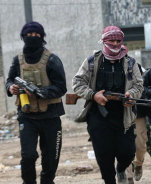
  • Iraqi tribal fighters.pngVarious tribal groups (an admittedly imprecise term) also fought against 3/2 and other coalition forces in far western Anbar.  These could be very localized, operating only in a particular village or district, under direction of a minor sheikh. In 2003 and 2004, most of these groups and cells were fighting against US troops, first against the Army’s 3rd Cav and then the Marines, and saw Zarqawi and his foreign fighters as allies against the occupiers. In fact, distinguishing between foreign fighters and local insurgents could be difficult. Clearly, 3/2 Marines were often fighting both foreign and local fighters in the same engagement.  By 2005, however, some of these tribal forces were rebelling against AQI. The most notable of these groups was the “Hamza Brigade”, an armed militia formed by the Albu Mahal tribe in and around Husaybah.  
The toughest tribe

I just ran across a really interesting blog, by John Mattel, a State Department Foreign Service Officer (FSO) who served on the Anbar Provincial Reconstruction Team (PRT) in 2007 and 2008.  He travelled widely throughout the province, and posted excellent observations. He was there “post-Awakening” and “post-surge”, so saw the dramatic progress being made, and openly calls the success achieved a victory.

John Mattell
John Mattell, western Anbar, 2008

To read through his blog, World-Wide-Mattel: Victory in Iraq, is like opening a window to see what western Iraq was starting to become in 2008-2010, and how the sacrifices of 2003-2007 led up to that progress. (But then you realize what came next, as it began to unravel and ISIS, which is AQI reborn, swept through Anbar again.)

One of his posts caught my attention, as it echoes a common theme; the Marines as a tribe.  As I’m writing about 3/2 and the wrenching experiences they went through, this rings true.  Here’s a recap of his post:

The Toughest Tribe in Anbar
August 29, 2008

[One] of the key components of sustainable power and influence is consistency.   If people understand that you will keep your word and behave in a consistent manner, they will respect you, whether or not they like you or what you are doing.  It is good to be loved; it is better to be respected.  

Western Anbar is a place of tribes and extended families.  Each group and sub-group has a reputation as do each of the sheiks.  These groups are constantly vying for advantage and position.  The Anbaris have come to see the Marines in terms they understand – as a tribe with a history and a reputation, although outside the tribal system.   

They have come to see the Marines as the toughest tribe in Anbar, the tribe with the longest memory and the one that will pay back in the terms used by the ancient Roman  Lucius Cornelius  Sulla (Felix) “No friend ever served me, and no enemy ever wronged me, whom I have not repaid in full.”  This is good.  The Marines have won respect in Anbar in their own terms.

The Marines provide consistent security which allowed the flowering of Anbar we are now seeing.  It is more than security from insurgents & AQI.  The Marines also provide a kind of impartial and honest outside force that helps guarantee the regional tribes and grouping against each other in their sometimes violent competition.  It is a smaller scale version of how the U.S. & NATO allowed the French and Germans to give up their ancient suspicions and hatreds since the security of an outside force eliminated incentives to stealthily surpass and surprise your opponent with a sudden, devastating, power.   The potential downside of what amounts to a hegemonic relationship is that it can break down if the outside force weakens or disappears before the embers of the ancient hatred and suspicion are gone. 

This interrelationship would be an interesting subject for an anthropologist to study.   People always understand new development in their own terms and try to make sense of them in relation to existing structures.   It is not surprising that the Anbaris would see the Marines as the toughest tribe in Anbar.   — John Mattell

Who was the enemy? part 1

Update: See part 2, for a fuller discussion…

(Kinda botched this post. Got all ‘rambley’, and didn’t get to the point… I feel like starting over, but will leave this up for now…)

This is a surprisingly difficult question. From the experts, you’ll commonly hear the answer, “Well, it’s complicated.” I’ve used that myself a few times. And its true, as far as it goes. Counter-insurgency warfare is anything but simple, and the Iraq War was radically un-simple. It was… well… complexity on steroids.

masked fightersOne of the big critiques coming from the press and think-tank crowd (then and now), was that the Bush Administration, Rumsfeld’s Defense Department and the U.S. military writ large didn’t have enough subtlety to understand who we were fighting in Iraq.  And that’s true in absolute terms.  In 2003, American politicos, the generals, the combat troops and the intelligence agencies, didn’t understand the nature of the “enemy” in Iraq.
But no one else did either…

And that’s what the critics don’t ever admit. In relative terms, they were just as clueless, and had nothing to offer.

By 2004, it was easy to see that there was a growing insurgency (actually several) despite Rumsfeld’s stubborn insistence otherwise. Certainly everyone on the ground in Iraq knew it. But just saying there were insurgents about, and that there seemed to be different groups of them, was easy. Any idiot journalist could say that.

But really understanding who they all were, and what their goals and differences were, and how to stop them? Yeah, that was the hard part. And in 2004 and 2005, a lot of people–intelligence officers, strategy advisors, operations planners, commanders–were working hard to figure that out. (see Net v Net for my own modest contribution)

(more soon…) 


Chris Ieva and the operational-level view

chris-ievaLast month I made contact with Chris Ieva, who was the Commander of Kilo Co. That initiated a great email exchange, which I’m including below (with his permission).

As a Capt in 2005, Chris led the battalion’s primary maneuver unit through all of 3/2’s major operations and most of the kinetic fights.  He has recently retired as a LtCol, and now lives with his family in New Jersey.

kilo-officers-cropped
Kilo Co. officers in 2005. (L-R) Capt Chris Ieva, Commander, John Hays XO, Nate Smith 2nd Plt, Mark Bullock 1st Plt, Clint Cummings 3rd Plt, Joey Clemmey Wpns Plt. (photo from Nate Smith’s blog)

After our initial contact on FB, Chris sent me a fantastic ‘40,000ft overview’ of western Iraq (AO Denver) during that timeframe, and the context that 3/2 was operating in.

I’m sharing it here because it is such a great ‘frame-setter’ for understanding the big picture.  At the end, he also discusses the current situation in Iraq & Syria.  I’m also including my response, which provides more details on my background and experience in Iraq.

–Ajax


On Mon, Jan 23, 2017 at 8:44 PM, Chris wrote:
Subj: Framing Email

Dear Ajax,

I wanted to provide you with quick reflections of our deployment.  As always, I wish to acknowledge the Marines and Sailors who I had the pleasure to serve alongside.  A decade removed, I am more humbled and respectful for those who made the ultimate sacrifice.  In case I drift off, I wanted to capture their sacrifice and dedication.  Instead of a chronological approach, I wish to provide some thematically organized impressions of the deployment to provide both context and perspective to the individual actions.

#1.  Economy of Force

A.  Operational.  After the 2d Battle of Fallujah in November 2014, Western Al Anbar was seen as an economy of force mission.  In the post Fallujah vacuum, AQI leadership, facilitators, and a growing Sunni foreign fighter connection grew along the rat-lines from the Syrian Border.  2d Marines (RCT 2), along with its battalions 2d LAR, 3/2 & 3/25, was affected by the latency between force and mission prioritization in a post Fallujah landscape.  3/2 had to give up one Rifle Company (Company L) for airfield security at Al Asad.  3/25 also had to yield forces for this task.  With one company from 3/2 in Husaybah (Company I) and one Company from 3/25 in Hit.  3/2’s Company K and 3/25’s Company L, plus 2d LAR from Rutbah and SOF forces, were the only maneuver forces between Al Qaim, Haditha, and Al Asad.  By the peak of the surge, this same battle space would be controlled by a force of about 8 US and Iraqi battalions!

B.  Tactically.  Company K was charged with Security of Al-Qaim and a radio relay station north of Camp Al-Qaim for VHF Communications.  Upon arrival, my team executed my vision for reducing force commitments for static missions along with the task of obtaining a standardization of processes, procedures, force rotations and logistics in the execution of these requirements.  I named the relay station Khe Sanh, where we would eventually send a squad for weekly rotations.  Senior NCOs, many who had diverse backgrounds, were invaluable in establishing this level of standardization. While the combat maybe glamorous, this necessary evil successfully protected two positions for an entire deployment in order to enable the preponderance of Company K along with Weapons Company 3/2 to operate offensively.

#2  Adjacent Forces

A.  Company L, 3/25.  3/25 was a reserve battalion based out of the Haditha Dam.  I believe their Lima Co. took the most KIA than any other Company in Iraq or Afghanistan.  3/25 took 48 KIA and over 200 wounded.  They had a hard mission and the reservists, quite simply, lacked the same technical proficiency in the heavy fighting as their active equivalents.  As an Officer and a Marine, my greatest career contribution was the technical proficiency of my company.  Quite simply, I ignored the prevailing attitudes at Lejeune before the deployment that we would be conducting ‘stability operations.’  I prioritized urban fighting with an emphasis on combined arms.  In all major named operations, we fought alongside Company L 3/25 more than 3/2 companies.  The RCT-2 Commander used Company K as a fire brigade across AO Denver.  I think we spent 4-6 weeks total in Haditha.  One time, after a sniper team was killed, and we were sent with Company L 3/2 to find an MIA sniper.  You cannot tell 3/2’s story by omitting 3/25.

B.  SOF.  Based on the increase of HVTs, many top tiered SOF and Special Forces operated from Al Qaim at the end of the deployment.  I know of 6 KIA from a top tier force (one was a friend).  They should not be overlooked.  My Company also displaced to Al Asad to support a 1st Force RECON raid around 4 July 2005.

#3.  Technical Proficiency.  Company K was blessed with a great bunch of SNCOs and LTs… gifted really.  In preparation for combat, I was ruthless stressing technical proficiency.  Rehearsals were real distance, real time, real gear, and real comms.  Amateurs practice till they get it right, Pros practice until they don’t get it wrong.

#4.  Operations SPEAR & MATADOR were at direct odds with prevailing COIN theory.  The organization & coagulation  of AQI insurgents required flat out destruction.  As a frame of reference, during SPEAR Company K called in over 30 airstrikes and used 400 tanks rounds in an area bounded 1 KM wide and maybe 2.5 KM deep in Karabilah.

#5.  The ‘Ho Chi Minh Trail’ in Iraq was 25 inches deep. This was my personal observation.  On our first operation in 2005, we exploited a cache.  Something like 100 arty rounds plus small arms.  I felt jubilant…we had saved the lives of fellow Marines.  Then we found more and more.  RCT 2 did an operation where they found 1,000 arty rounds plus other weapons just by walking along the Euphrates.  Two weeks later, they went back out and found the same amount.  We had an insurgent network who not only had 1,000 arty rounds (about 40,000 lbs total!), but could logistically move and store their weapons at scale.  On my first operation to Haditha, we passed Ammo Supply Point (ASP) Wolf.  Out in the middle of the desert, there were arty rounds everywhere.  We stopped to blow rounds, but were overwhelmed… too many… had to make arrival times @ Haditha.  I found out that ASP Wolf was a former Iraqi ASP.  I did my research, and at the time there were 4,000 ASPs across Iraq. The private contract to sweep them was only 24 inches deep and only rounds greater than 122mm were swept.  When I did a staff tour in Iraq in 2009, I learned that 4,000 had eventually been swept, and so finally insurgents had resorted to Homemade Explosive (HME) and importing illicit weapons.  Outside of our raid cycle, named operations, guarding Al-Qaim and Khe Sanh, I would try to find unexploded ordinance (UXO) at known ASPs in my AO.  Most notably, the H series of airfields (along the former H-1 pipeline to Haifa) was rich in UXO.  I wish in 2003 US forces would have done a better sweep.  I was shocked considering the WMD issue.  I would apply this observation/lesson learned in Afghanistan in 2011.

#6.  Anbar Awakening.  My staff tour in 2009 gave me a better understanding of the dynamics inside Iraq… meaning I had no understanding.  Too many people thought they understood the situation and applied their own cognitive filters (myself included) to this problem set.  The fall of Husaybah to Al Qaeda towards the end of deployment, right before 3/6 arrived, was a weird turning point.  Chris Starling (Operations Officer for RCT-2), who is a friend and mentor, has a really good handle across 3/2 & 3/6 deployment.  I attended the Naval Postgraduate School from 2006-2008 for a dual degree in Systems Engineering and International Relations.  For many of my papers and thesis work, I explored these concepts.  While there is an art in simplification, it can be dangerous.  More than once, I have used this analogy in articulating the challenge of predictive analysis:  In last year’s ESPN NCAA DIV I Men’s B-Ball bracket contest, there was only one person who predicted the course of the tournament exactly.  Think about that!  Known rankings, known assets to each team and strict rule-based engagements (games) and construct, but only one dude got it right.  I think predicting and understanding these tribal, political, and social dynamics should be approached with the same caution as you would predicting a bracket in an office pool.

#7.  Iraq & Syria Today.  1/7, 3/2, and 3/6’s time in Western Al Anbar and Al Qaim should be a case study for the present state of play with ISIS in Iraq & Syria.  Who are the good guys?  Who are the bad?  Although ISIS is a terrorist organization, it is also a Sunni nationalist group.  As a civilian now, I just recently saw that the Iraqi government voted to incorporate Shia Militias into the Iraqi Army…the very thing US Forces tried to prevent.  I am 100% positive that the reports of Shia atrocities against Sunnis are very much true and likely underreported.  Newspapers say that there are 100,000 Iranian troops fighting in Iraq.  While the preponderance of the media today is rooting for the re-capture of Mosul as a liberation akin to Paris ’44, they all but ignore that the elements at play are very different.  During the 2016 Presidential debates, I watched Secretary Clinton and Senator Kaine announce a policy decision to have an INTEL surge to get Baghdadi, the leader of ISIS.  But they forgot, omitted, or simply did not know, that we already captured & released him in 2005 and the same in 2009.  Our #1 enemy was someone who we had and let go… two times.  President Trump and VP Pence missed a chance to pounce on the incongruence in approach and history, but likely forgot, omitted, or simply did not know that we already had the dude before.  Sorry to bang on about this point, but it is startling!

I hope this provides some measure of context, I am happy to answer any questions!

Semper Fi,

Chris


On Tue, Jan 24, 2017 at 1:08 AM, Ajax Trueblood wrote:

Subj: Re: Framing Email

Chris,

Fantastic overview! Thank you so much for taking that time.  Let me tell you a little about myself, and then about the research I’ve done so far:

I’m a retired Air Force intel guy, but I’m actually very attuned to ground operations, COIN precepts, the progress of strategy and operations in Iraq, and the origins of the Awakening.  In 2004/05, I served a tour at the CAOC at Al-Udeid AB in Qatar, but with several in-and-out trips into Iraq. I was providing intel support to a ground TF around Balad, so struggled (like everyone then) to understand the multi-faceted, fast-morphing insurgency. Then, in 2007, I was attached to the Army’s 3rd ID during the surge and was involved in small exploitation teams supporting maneuver units south of Baghdad. I was at FOB Kalsu in the ‘southern belt’ and then out by Al-Kut and the Iranian border, trying to help stanch the flow of EFPs and other ‘accelerants’.  The effects of the Awakening were obvious and exciting.

Also, I’m the father of an Army Ranger, in the 75th RGR REGT.  He’s part of those ‘upper tier’ operators you mentioned, with 11 combat deployments in IZ and AF.  So I have a very personal connection to someone at the speartip, and have learned much from him, both in concrete and intangible ways.

And, being an intel guy from way back, I have a knack for putting pieces together to form the bigger picture, and ‘filling in the holes’.  At this point, I’ve been studying the campaign in west Anbar for several years, and have amassed quite a chunk of references and reports.  And in just the last month, I’ve started reaching many 3/2 vets through FB (incl quite a few Kilo Marines). They have expanded my understanding in many ways.

I’m not saying this to impress, just so you know I’m not your typical ‘outsider’ (like a staff researcher, reporter or academic) coming in to skim off the surface. Outside of 3/2, I think it would be hard to find anyone else that understands more about your 2005 deployment, the dynamics of your AO and the operational environment. I have truly been digging deep.

Having said that, your ‘frame setter’ is outstanding and very valuable. I’m well aware of the ‘macro’ factors you outline (economy of force, RCT2s campaign plan, AQI’s intent, etc), but several of your emphasis items have struck home — 3/25 and its role in the story, the dug-in enemy in Karabilah, and the TF side of the campaign.

Along those lines, one of the sections I’m working on is what I call the ‘four-way war’.  Which entails 3/2 and RCT2 engaging in very kinetic ‘security & stability ops’, the Albu-Mahal tribe and allies fighting against AQI and their allies (red v red), the ODAs engaging the tribes, and the TF going after Zarqawi’s network.  I’ll focus on 3/2’s operations, but place them in the full context of the other three.

Anyway, I’m really glad I found you, and that you’ve responded (It was Gabe Diana that helped me find your FB profile).  I look forward to getting to know you better and learning more from you.

Respectfully,

–Ajax

Film by 3/2 Marine, Noah Cass

noah-runningShould have put this up awhile back, but got behind… I made contact w Noah Cass a couple weeks ago. In 2005 he was a gunner in WarPig (Weapons Company).  Now he’s made an independent film, The last time I heard true silence, about his experiences in Iraq and his life since coming home. Here’s an excerpt from the web page…

When the war you’ve lived through follows you home, you can’t run away from it, but you can run through it.  

Upon returning from Iraq, Noah struggles to transition back into civilian life. His attempts to reintegrate are repeatedly thwarted by problems he never faced before: aggressive behavior, alcohol, addiction, depression, difficulty holding down a job and holding onto a relationship. After losing more friends to suicide than war, he finds himself hitting rock bottom so he starts running and he never stops.

Now a father and husband, Noah enters a 50-mile wilderness race, pushing his mind and his body to their limits.


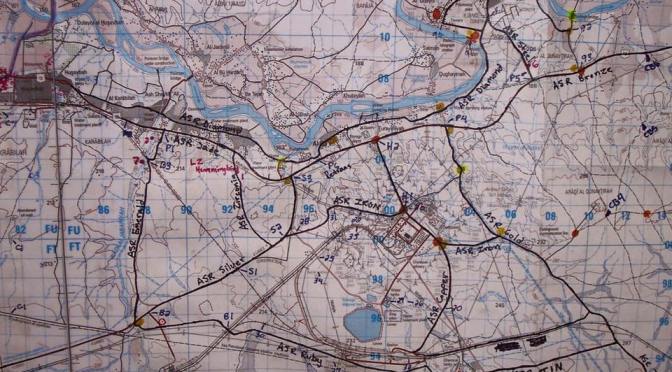
My kingdom for a map

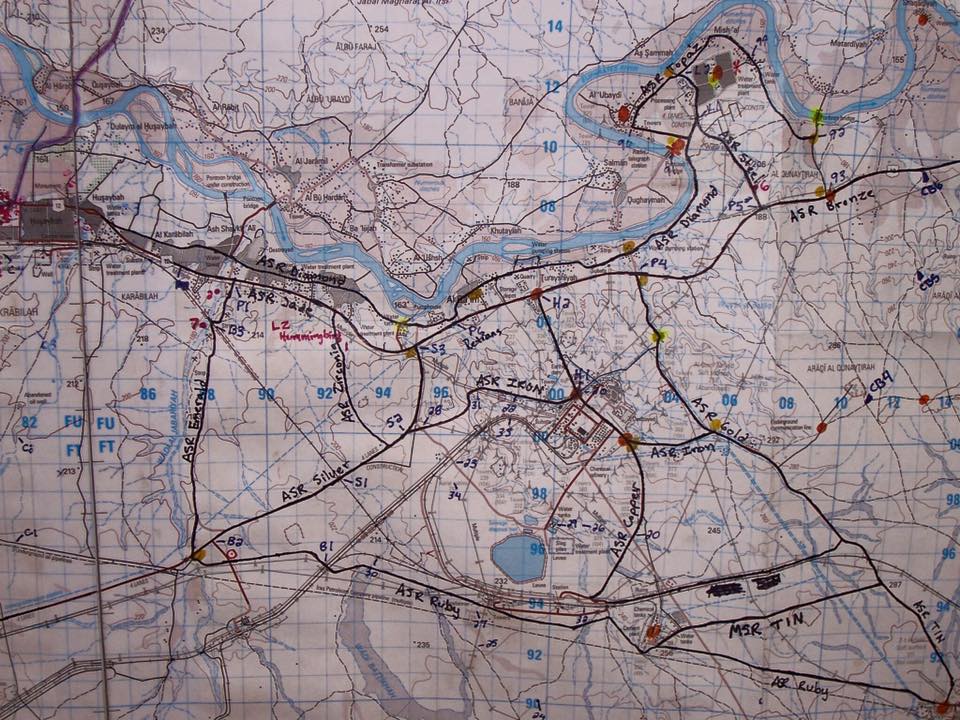
Yesterday I ran across pure gold. This appears to be an annotated operations map from US forces (prob 3/2) in the Al-Qaim area, and it looks like it dates from 2005–at least I don’t see certain battle positions that were set up under 3/6.  It was on someone’s Facebook profile.

This helps immensely, as I have been struggling to figure out where all the ASRs and MSRs were.  One of the things I’m working on is a Google Earth map of the AO, so if anyone has any amplifying information on this, or (hopefully) has other old maps to share, I’d love to see those.

–Ajax 

ops-map-for-32

Monster sandstorm, 26Apr05

Sandstorm Gannon
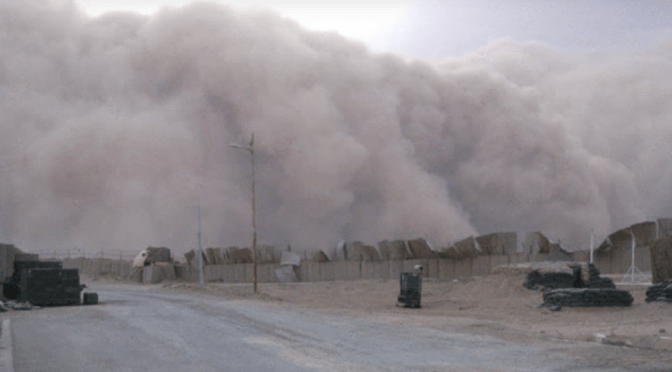
This is clearly a large sandstorm hitting Gannon, probably the big one on 26 April.

A lot of people remember the huge sandstorm that swept over western Iraq on 26 Apr 2005. There are scads of photos (and several videos) of it on the web, and many military personnel wrote about it.

Several 3/2 Marines remember a sand storm swallowing everything up and covering everything with fine, talcum-powder sand.  Most think it was sometime before Operation Matador (8 May). So, I’m assuming it was the 26 April storm, but am always willing to be corrected.

Joshua Cepeda, in Weapons Co. (Warpig), remembers when the wall of sand hit Camp Al-Qaim:

We quickly tried to cover the trucks as well as we could. But after awhile, it just got completely black. It was impossible to see in that crap. So all operations ended up stopping… We were able to see the sandstorm coming before it hit, so we had a heads-up.

sandstorm-16
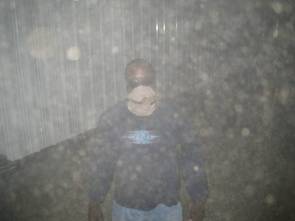
Darkness at midday. Photo from Al-Asad, but it must have been similar at Al-Qaim and Gannon

Some guys went out with gas masks to try and stay out there as long at they could to cover the trucks. I remember them doing a pretty good job but not too long into the storm it got completely dark and not even the gas masks [could] keep the dust out.

If anyone can confirm the date of this big storm, or has photos of it over Al-Qaim or Camp Gannon, please let me know.

–Ajax


sandstorm-al-asad
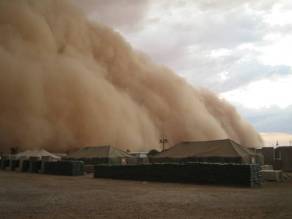
Another photo from Al-Asad