All posts by ajaxtrueblood

The toughest tribe

I just ran across a really interesting blog, by John Mattel, a State Department Foreign Service Officer (FSO) who served on the Anbar Provincial Reconstruction Team (PRT) in 2007 and 2008.  He travelled widely throughout the province, and posted excellent observations. He was there “post-Awakening” and “post-surge”, so saw the dramatic progress being made, and openly calls the success achieved a victory.

John Mattell
John Mattell, western Anbar, 2008

To read through his blog, World-Wide-Mattel: Victory in Iraq, is like opening a window to see what western Iraq was starting to become in 2008-2010, and how the sacrifices of 2003-2007 led up to that progress. (But then you realize what came next, as it began to unravel and ISIS, which is AQI reborn, swept through Anbar again.)

One of his posts caught my attention, as it echoes a common theme; the Marines as a tribe.  As I’m writing about 3/2 and the wrenching experiences they went through, this rings true.  Here’s a recap of his post:

The Toughest Tribe in Anbar
August 29, 2008

[One] of the key components of sustainable power and influence is consistency.   If people understand that you will keep your word and behave in a consistent manner, they will respect you, whether or not they like you or what you are doing.  It is good to be loved; it is better to be respected.  

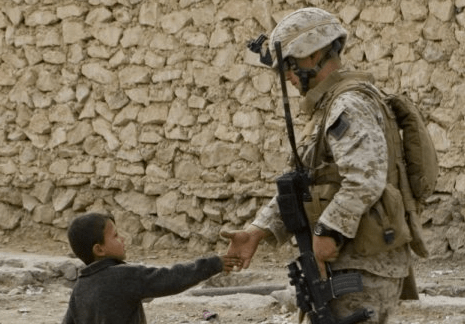
Western Anbar is a place of tribes and extended families.  Each group and sub-group has a reputation as do each of the sheiks.  These groups are constantly vying for advantage and position.  The Anbaris have come to see the Marines in terms they understand – as a tribe with a history and a reputation, although outside the tribal system.   

They have come to see the Marines as the toughest tribe in Anbar, the tribe with the longest memory and the one that will pay back in the terms used by the ancient Roman  Lucius Cornelius  Sulla (Felix) “No friend ever served me, and no enemy ever wronged me, whom I have not repaid in full.”  This is good.  The Marines have won respect in Anbar in their own terms.

The Marines provide consistent security which allowed the flowering of Anbar we are now seeing.  It is more than security from insurgents & AQI.  The Marines also provide a kind of impartial and honest outside force that helps guarantee the regional tribes and grouping against each other in their sometimes violent competition.  It is a smaller scale version of how the U.S. & NATO allowed the French and Germans to give up their ancient suspicions and hatreds since the security of an outside force eliminated incentives to stealthily surpass and surprise your opponent with a sudden, devastating, power.   The potential downside of what amounts to a hegemonic relationship is that it can break down if the outside force weakens or disappears before the embers of the ancient hatred and suspicion are gone. 

This interrelationship would be an interesting subject for an anthropologist to study.   People always understand new development in their own terms and try to make sense of them in relation to existing structures.   It is not surprising that the Anbaris would see the Marines as the toughest tribe in Anbar.   — John Mattell
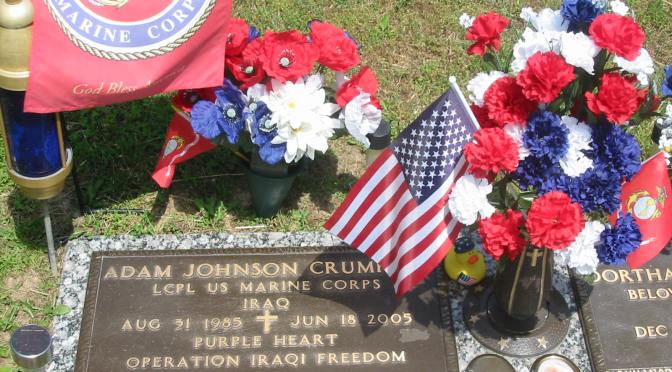
Remembering Adam Crumpler, KIA 18 June 2005

Update (17jun18) – The chapters on Operation Spear have been finished for some time.  The first is Tip of the Spear, which covers Day 1 and the middle of Day 2 of the operation.  The 2nd is The Hard Edge, which starts with the action that led to the loss of LCpl Adam Crumpler.

CrumplerKIAthumbUpdate (10jul17) – I’ve got the draft section as complete as possible right now, and I’m pretty comfortable with it.  The eye witnesses I’ve interviewed have all approved it, so I’m ready to share. This was a challenge for me as a writer, emotionally and technically. A brave young Marine died, and by writing about it I realized I was creating a monument of sorts; to honor him, the men who went into battle with him, and his family.  I wanted to make sure I got the details right and that I treated this incident with respect.  I hope I’ve accomplished that.  It will be part of a larger chapter about Operation Spear, which I’m still slogging away on.  There will be sections before and after this that put things into context.

Crumpler smiling

(16jun17) – For the last couple of weeks, I’ve been writing an account of the engagement in Karabilah, during Operation Spear, that resulted in the death of LCpl Adam Crumpler.  In a few days it will be the anniversary of that date, 18 June 2005.

Writing about this has been a hard task, and I have proceeded carefully to treat the event with as much accuracy, fidelity and respect as possible.  In doing so, I have interviewed several Marines who were there, and they have shared with me their detailed first-hand accounts of what happened, and why.  They’ve shared very personal feelings, and the emotional impact the event has had on them.  I am grateful, and honored, by the confidence they have shown in me to tell the story.

With their ongoing input, I am still editing and refining the section. I am not sure when I’ll be ready to post it here, but that is what I’d like to do–when it’s appropriate.

Also, I’m still searching out members of Kilo Co, 1st Platoon, especially those in 1st Squad who were with Adam as they cleared that house.  If someone was there, and wants to add to my understanding of what happened, I’d like to talk to you.

crumpler smiling

In the meantime, I just want to remember and honor a brave Marine who gave his life in his country’s service, and literally placed himself in the line of fire to protect his squad-mates and friends. May he Rest in Peace, and may God bless his family and loved ones.

Semper Fi…

–Ajax

Saudi suicide bomber at Gannon


firetruck chassis
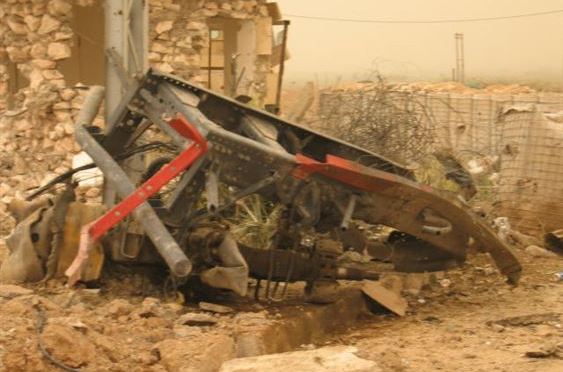
Post-blast remains of the infamous firetruck, one of the suicide truck bombs that struck Camp Gannon

I just ran across a Washington Post article from 2005 that reports the name of a Saudi national who was allegedly one of the suicide bombers that attacked Camp Gannon on 11 Apr 2005.  The article acknowledges that there’s no way to confirm the information that was posted on jihadist websites a few days after the attack.

The article is titled “Martyrs in Iraq mostly Saudis”, by Susan Glasser, and you can see the full version here.  Below are the relevant sections about the 11 Apr attack:

Before Hadi bin Mubarak Qahtani exploded himself into an anonymous fireball, he was young and interested only in “fooling around.”  Like many Saudis, he was said to have experienced a religious awakening after the Sept. 11, 2001, attacks on the United States and dedicated himself to Allah, inspired by “the holy attack that demolished the foolish infidel Americans and caused many young men to awaken from their deep sleep,” according to a posting on a jihadist Web site.  On April 11, he died as a suicide bomber, part of a coordinated insurgent attack on a U.S. Marine base in the western Iraq city of Qaim. Just two days later, “the Martyrdom” of Hadi bin Mubarak Qahtani was announced on the Internet, the latest requiem for a young Saudi man who had clamored to follow “those 19 heroes” of Sept. 11 and had found in Iraq an accessible way to die.

<snip>

Biographical details are often sketchy in the online obituaries, as is the case with Qahtani, the young Saudi said to have died April 11 while attacking a U.S. Marine base in the western Iraqi city of Qaim. The account of his death located by Kohlmann on the Internet does not say whether Qahtani was driving the commandeered dump truck that barreled onto the base, wreaking havoc before exploding, or whether he was in one of two other vehicles that blew up while another group of fighters opened fire on Marines.

It gives no more identifying details than his name — indicating he was part of a well-known Saudi tribe that also produced the al Qaeda member known as the so-called 20th hijacker, Mohamed Qahtani, who was turned away from entering the country by suspicious U.S. airport officials in August 2001.

Who was the enemy? part 1

Update: See part 2, for a fuller discussion…

(Kinda botched this post. Got all ‘rambley’, and didn’t get to the point… I feel like starting over, but will leave this up for now…)

This is a surprisingly difficult question. From the experts, you’ll commonly hear the answer, “Well, it’s complicated.” I’ve used that myself a few times. And its true, as far as it goes. Counter-insurgency warfare is anything but simple, and the Iraq War was radically un-simple. It was… well… complexity on steroids.

masked fightersOne of the big critiques coming from the press and think-tank crowd (then and now), was that the Bush Administration, Rumsfeld’s Defense Department and the U.S. military writ large didn’t have enough subtlety to understand who we were fighting in Iraq.  And that’s true in absolute terms.  In 2003, American politicos, the generals, the combat troops and the intelligence agencies, didn’t understand the nature of the “enemy” in Iraq.

But no one else did either…

And that’s what the critics don’t ever admit. In relative terms, they were just as clueless, and had nothing to offer.

By 2004, it was easy to see that there was a growing insurgency (actually several) despite Rumsfeld’s stubborn insistence otherwise. Certainly everyone on the ground in Iraq knew it. But just saying there were insurgents about, and that there seemed to be different groups of them, was easy. Any idiot journalist could say that.

But really understanding who they all were, and what their goals and differences were, and how to stop them? Yeah, that was the hard part. And in 2004 and 2005, a lot of people–intelligence officers, strategy advisors, operations planners, commanders–were working hard to figure that out. (see Net v Net for my own modest contribution)

(more soon…) 


YUT!!! Encouragement from a Marine

Got a great text from India Co. Marine, Joey Habay, who was a Squad Leader in the Wpns Platoon.  He and I have had several FB text sessions, and he was one of the sources that helped me as I put together the chapter about the attack on Gannon.

After I sent him the latest draft, he responded with a highly encouraging text. I can’t tell you how much this meant to me. As I’ve related to some, this whole process is like climbing a mountain, and I can’t see the peak. There’s a lot of clouds and mist, and I just gotta keep putting one foot in front of the other.  Some days are harder than others.  So, when Joey sent me this, it was like a big shot of adrenaline (shared w permission):

Joey HabayYour story of us marines that day was spot on. Awsome job!! YUT!!!!!!. (Marine term means like saying bad ass or f’ing great). Now people will believe me when I tell the story of April 11th 2005. That day, and the battle for Naseriyah in 03′, I re-live in my dreams. Thanks from my heart for telling our story for all the great marines involved on that day
Now I just gotta find out where YUT came from. Its new to me.  Is it an acronym? If someone knows the origin, I’d love to hear it.

–Ajax

Videos: SAW on cyclic / breaking glass

These two videos add a little bit of understanding as to what happened during the April 11th attack on Gannon, and how the dumptruck and firetruck VBIEDs were stopped, or deterred from penetrating the perimeter, where they would have been far more lethal.

The first just shows a civilian firearms enthusiast, firing an M249 SAW at the full ‘cyclic’ rate, without letting off the trigger. This is essentially the same type of weapon that Josh Butler fired at the VBIEDs.  And it’s a vivid example of how fast the M249 will go through ammo on cyclic.

This second video is from the Tactical Rifleman YouTube channel, and features Rob French, former Force Recon Marine and now an instructor with the Tier 1 Group, showing the impact of bullets on various types of glass, including “bullet-proof” windshields (hint: they’re not really bullet-proof).  This really illustrates the effects that Butler’s 5.56mm rounds probably had on the VBIED windshields during the 11 Apr 2005 attack.


Frank Diorio’s interview at VMI

Frank DiorioCapt Frank Diorio was India Company’s Commander in 2005. He is now a LtCol and still on active duty. One of the key sources I’ve used, especially for the Attack on Gannon chapter, is an interview he gave at the Virginia Military Institute in 2008.  He talks at length about India, the April 11th attack and the subsequent efforts he and his Marines made to engage with locals as they began fighting against AQI.

VMI logThe full transcript of the interview is available on VMI’s website.
It is part of the Military Oral History Project, run by their Adams Center for Military History and Strategic Analysis. VMI Cadet Zachary Carmen conducted the interview on March 28, 2008.

Kilo in Haditha, Chris Ieva

aavflipped
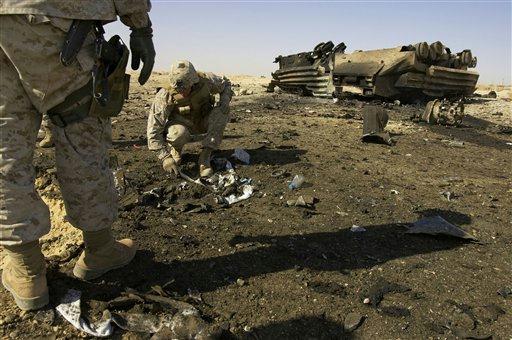
Marines inspect the remains of an AAV from 3/25 BN, destroyed by an IED near Haditha on 3 Aug 2005. 14 Marines and a civilian interpreter were killed.  (AP photo)

An account by Capt. Chris Ieva (now LtCol retired), CO of Kilo Company, describing Kilo’s operations in August 2005, during Operation Quick Strike (used with permission):

My company worked with 3rd Bn, 25th Marines in Haditha where the dam was located on the Euphrates. Tragically, another 3/25 AAV (right) was hit responding to the loss of a six man sniper team around the old soccer stadium. At the time, the body of one of the snipers was still not recovered.

We immediately left the Syrian border with a little over half of my company pushing about a hundred miles to the east, staged in the desert in order to first seize the west half of Haditha.

Even though this was far away from our area, it was our third time operating in Haditha for an extensive period. The battalion’s first and only killed [during this operation] occurred that morning when Iraqi Special Operations forces lost four, as Lima 3/2 cleared a refinery to the south while my company, Kilo 3/2, pushed in from the east.

The locals knew…I mean damn well knew… we were not playing, because 3/25’s sniper was still missing. That is when we heard 3/25 lost an entire AAV on the other side of the river. It was 3/25 battalion’s and its Lima company’s second lost AAV resulting in mass casualties. The IED lifted the AAV and actually flipped the vehicle upside down. The other was lost earlier during Operation MATADOR during a forward passage of lines where I worked the MEDEVAC.  

I think around the same day, we learned that the sniper’s body was found and we heard that he was murdered on a bridge spanning the Euphrates between Haditha and Barwana. I think we spent about a week there occupying the town, running patrols, and trying to develop intel to conduct raids at night by foot.

Two times we played a trick where we would show a position during a day, pull out at night and leave chem lights behind, but have a sniper team in overwatch. So I think 2-3 times, these positions were shot at and the snipers immediately killed the attackers resulting in 2 enemy killed. We also ran a clearing operation that gave the enemy in the palm groves an obvious approach, but we had a sniper team in ambush resulting in another 3 enemy killed. One shot was an amazing face shot at 300 meters.

We captured two others who were not killed because they just dropped their AKs. One of the captured was a brother of one of the enemy dead. I later learned that these two guys were immediately released because they said that they were fishing, even though we documented the evidence and articulated the incident.

One squad had a hair raising moment where they entered a building rigged with multiple IEDs, but it never blew. I think we destroyed two buildings that were rigged with airstrikes .

The only real action that week was a blue van and a suicide laden vehicle. A heavy machine gun team engaged the suicide vehicle resulting in secondary explosions and another group, after a brief firefight, made an escape in a blue 1970s van. Luckily, there was a split section of a cobra and huey gunship that came on station…that as we lost contact with the van, but it was quickly engaged and destroyed. We never bothered to count the enemy dead.

chris-ieva3About a year later, I was at a party where a Marine door gunner was telling a story of lighting up a 1970s blue van and we realized it was the same engagement. I always felt some small measure of payback by the little gains we achieved during the week.  
–Chris Ieva

Defending Gannon, Ron Jackson

An account by LCpl Ron Jackson, 1st Platoon, India Co., describing the defense of Camp Gannon on 11 Apr 2005. Once the attack started, he rushed to a post on the south perimeter of the base (used with permission):

ron-jacksonMy platoon was off and in reserve at the time of explosion. We all went and reinforced the positions. I went to post 7.  It was scary, but then your training takes over. I got blown out of my rack when the attack started. Mortars landed on top of us. I had that moment of intense fear before running out to post 7, but you have a bigger fear of letting your brothers down.

Two guys were in P7 when I got there. I brought extra ammo. Two of us had M-16s and the other had a SAW. We were receiving heavy small arms, rocket, and mortar fire from the south and east.  I could see muzzle flashes and men on the rooftops. We started engaging them and reporting what we saw to the COC.  As we fired back at the muzzle flashes, we were aggressive but professional, if that makes sense.  

–Ron Jackson

gannon-posts
Camp Gannon guard posts, P1 through P8. Jackson was manning P7 along the southern perimeter wall