All posts by ajaxtrueblood

Chris Ieva and the operational-level view

chris-ievaLast month I made contact with Chris Ieva, who was the Commander of Kilo Co. That initiated a great email exchange, which I’m including below (with his permission).

As a Capt in 2005, Chris led the battalion’s primary maneuver unit through all of 3/2’s major operations and most of the kinetic fights.  He has recently retired as a LtCol, and now lives with his family in New Jersey.

kilo-officers-cropped
Kilo Co. officers in 2005. (L-R) Capt Chris Ieva, Commander, John Hays XO, Nate Smith 2nd Plt, Mark Bullock 1st Plt, Clint Cummings 3rd Plt, Joey Clemmey Wpns Plt. (photo from Nate Smith’s blog)

After our initial contact on FB, Chris sent me a fantastic ‘40,000ft overview’ of western Iraq (AO Denver) during that timeframe, and the context that 3/2 was operating in.

I’m sharing it here because it is such a great ‘frame-setter’ for understanding the big picture.  At the end, he also discusses the current situation in Iraq & Syria.  I’m also including my response, which provides more details on my background and experience in Iraq.

–Ajax


On Mon, Jan 23, 2017 at 8:44 PM, Chris wrote:
Subj: Framing Email

Dear Ajax,

I wanted to provide you with quick reflections of our deployment.  As always, I wish to acknowledge the Marines and Sailors who I had the pleasure to serve alongside.  A decade removed, I am more humbled and respectful for those who made the ultimate sacrifice.  In case I drift off, I wanted to capture their sacrifice and dedication.  Instead of a chronological approach, I wish to provide some thematically organized impressions of the deployment to provide both context and perspective to the individual actions.

#1.  Economy of Force

A.  Operational.  After the 2d Battle of Fallujah in November 2014, Western Al Anbar was seen as an economy of force mission.  In the post Fallujah vacuum, AQI leadership, facilitators, and a growing Sunni foreign fighter connection grew along the rat-lines from the Syrian Border.  2d Marines (RCT 2), along with its battalions 2d LAR, 3/2 & 3/25, was affected by the latency between force and mission prioritization in a post Fallujah landscape.  3/2 had to give up one Rifle Company (Company L) for airfield security at Al Asad.  3/25 also had to yield forces for this task.  With one company from 3/2 in Husaybah (Company I) and one Company from 3/25 in Hit.  3/2’s Company K and 3/25’s Company L, plus 2d LAR from Rutbah and SOF forces, were the only maneuver forces between Al Qaim, Haditha, and Al Asad.  By the peak of the surge, this same battle space would be controlled by a force of about 8 US and Iraqi battalions!

B.  Tactically.  Company K was charged with Security of Al-Qaim and a radio relay station north of Camp Al-Qaim for VHF Communications.  Upon arrival, my team executed my vision for reducing force commitments for static missions along with the task of obtaining a standardization of processes, procedures, force rotations and logistics in the execution of these requirements.  I named the relay station Khe Sanh, where we would eventually send a squad for weekly rotations.  Senior NCOs, many who had diverse backgrounds, were invaluable in establishing this level of standardization. While the combat maybe glamorous, this necessary evil successfully protected two positions for an entire deployment in order to enable the preponderance of Company K along with Weapons Company 3/2 to operate offensively.

#2  Adjacent Forces

A.  Company L, 3/25.  3/25 was a reserve battalion based out of the Haditha Dam.  I believe their Lima Co. took the most KIA than any other Company in Iraq or Afghanistan.  3/25 took 48 KIA and over 200 wounded.  They had a hard mission and the reservists, quite simply, lacked the same technical proficiency in the heavy fighting as their active equivalents.  As an Officer and a Marine, my greatest career contribution was the technical proficiency of my company.  Quite simply, I ignored the prevailing attitudes at Lejeune before the deployment that we would be conducting ‘stability operations.’  I prioritized urban fighting with an emphasis on combined arms.  In all major named operations, we fought alongside Company L 3/25 more than 3/2 companies.  The RCT-2 Commander used Company K as a fire brigade across AO Denver.  I think we spent 4-6 weeks total in Haditha.  One time, after a sniper team was killed, and we were sent with Company L 3/2 to find an MIA sniper.  You cannot tell 3/2’s story by omitting 3/25.

B.  SOF.  Based on the increase of HVTs, many top tiered SOF and Special Forces operated from Al Qaim at the end of the deployment.  I know of 6 KIA from a top tier force (one was a friend).  They should not be overlooked.  My Company also displaced to Al Asad to support a 1st Force RECON raid around 4 July 2005.

#3.  Technical Proficiency.  Company K was blessed with a great bunch of SNCOs and LTs… gifted really.  In preparation for combat, I was ruthless stressing technical proficiency.  Rehearsals were real distance, real time, real gear, and real comms.  Amateurs practice till they get it right, Pros practice until they don’t get it wrong.

#4.  Operations SPEAR & MATADOR were at direct odds with prevailing COIN theory.  The organization & coagulation  of AQI insurgents required flat out destruction.  As a frame of reference, during SPEAR Company K called in over 30 airstrikes and used 400 tanks rounds in an area bounded 1 KM wide and maybe 2.5 KM deep in Karabilah.

#5.  The ‘Ho Chi Minh Trail’ in Iraq was 25 inches deep. This was my personal observation.  On our first operation in 2005, we exploited a cache.  Something like 100 arty rounds plus small arms.  I felt jubilant…we had saved the lives of fellow Marines.  Then we found more and more.  RCT 2 did an operation where they found 1,000 arty rounds plus other weapons just by walking along the Euphrates.  Two weeks later, they went back out and found the same amount.  We had an insurgent network who not only had 1,000 arty rounds (about 40,000 lbs total!), but could logistically move and store their weapons at scale.  On my first operation to Haditha, we passed Ammo Supply Point (ASP) Wolf.  Out in the middle of the desert, there were arty rounds everywhere.  We stopped to blow rounds, but were overwhelmed… too many… had to make arrival times @ Haditha.  I found out that ASP Wolf was a former Iraqi ASP.  I did my research, and at the time there were 4,000 ASPs across Iraq. The private contract to sweep them was only 24 inches deep and only rounds greater than 122mm were swept.  When I did a staff tour in Iraq in 2009, I learned that 4,000 had eventually been swept, and so finally insurgents had resorted to Homemade Explosive (HME) and importing illicit weapons.  Outside of our raid cycle, named operations, guarding Al-Qaim and Khe Sanh, I would try to find unexploded ordinance (UXO) at known ASPs in my AO.  Most notably, the H series of airfields (along the former H-1 pipeline to Haifa) was rich in UXO.  I wish in 2003 US forces would have done a better sweep.  I was shocked considering the WMD issue.  I would apply this observation/lesson learned in Afghanistan in 2011.

#6.  Anbar Awakening.  My staff tour in 2009 gave me a better understanding of the dynamics inside Iraq… meaning I had no understanding.  Too many people thought they understood the situation and applied their own cognitive filters (myself included) to this problem set.  The fall of Husaybah to Al Qaeda towards the end of deployment, right before 3/6 arrived, was a weird turning point.  Chris Starling (Operations Officer for RCT-2), who is a friend and mentor, has a really good handle across 3/2 & 3/6 deployment.  I attended the Naval Postgraduate School from 2006-2008 for a dual degree in Systems Engineering and International Relations.  For many of my papers and thesis work, I explored these concepts.  While there is an art in simplification, it can be dangerous.  More than once, I have used this analogy in articulating the challenge of predictive analysis:  In last year’s ESPN NCAA DIV I Men’s B-Ball bracket contest, there was only one person who predicted the course of the tournament exactly.  Think about that!  Known rankings, known assets to each team and strict rule-based engagements (games) and construct, but only one dude got it right.  I think predicting and understanding these tribal, political, and social dynamics should be approached with the same caution as you would predicting a bracket in an office pool.

#7.  Iraq & Syria Today.  1/7, 3/2, and 3/6’s time in Western Al Anbar and Al Qaim should be a case study for the present state of play with ISIS in Iraq & Syria.  Who are the good guys?  Who are the bad?  Although ISIS is a terrorist organization, it is also a Sunni nationalist group.  As a civilian now, I just recently saw that the Iraqi government voted to incorporate Shia Militias into the Iraqi Army…the very thing US Forces tried to prevent.  I am 100% positive that the reports of Shia atrocities against Sunnis are very much true and likely underreported.  Newspapers say that there are 100,000 Iranian troops fighting in Iraq.  While the preponderance of the media today is rooting for the re-capture of Mosul as a liberation akin to Paris ’44, they all but ignore that the elements at play are very different.  During the 2016 Presidential debates, I watched Secretary Clinton and Senator Kaine announce a policy decision to have an INTEL surge to get Baghdadi, the leader of ISIS.  But they forgot, omitted, or simply did not know, that we already captured & released him in 2005 and the same in 2009.  Our #1 enemy was someone who we had and let go… two times.  President Trump and VP Pence missed a chance to pounce on the incongruence in approach and history, but likely forgot, omitted, or simply did not know that we already had the dude before.  Sorry to bang on about this point, but it is startling!

I hope this provides some measure of context, I am happy to answer any questions!

Semper Fi,

Chris


On Tue, Jan 24, 2017 at 1:08 AM, Ajax Trueblood wrote:

Subj: Re: Framing Email

Chris,

Fantastic overview! Thank you so much for taking that time.  Let me tell you a little about myself, and then about the research I’ve done so far:

I’m a retired Air Force intel guy, but I’m actually very attuned to ground operations, COIN precepts, the progress of strategy and operations in Iraq, and the origins of the Awakening.  In 2004/05, I served a tour at the CAOC at Al-Udeid AB in Qatar, but with several in-and-out trips into Iraq. I was providing intel support to a ground TF around Balad, so struggled (like everyone then) to understand the multi-faceted, fast-morphing insurgency. Then, in 2007, I was attached to the Army’s 3rd ID during the surge and was involved in small exploitation teams supporting maneuver units south of Baghdad. I was at FOB Kalsu in the ‘southern belt’ and then out by Al-Kut and the Iranian border, trying to help stanch the flow of EFPs and other ‘accelerants’.  The effects of the Awakening were obvious and exciting.

Also, I’m the father of an Army Ranger, in the 75th RGR REGT.  He’s part of those ‘upper tier’ operators you mentioned, with 11 combat deployments in IZ and AF.  So I have a very personal connection to someone at the speartip, and have learned much from him, both in concrete and intangible ways.

And, being an intel guy from way back, I have a knack for putting pieces together to form the bigger picture, and ‘filling in the holes’.  At this point, I’ve been studying the campaign in west Anbar for several years, and have amassed quite a chunk of references and reports.  And in just the last month, I’ve started reaching many 3/2 vets through FB (incl quite a few Kilo Marines). They have expanded my understanding in many ways.

I’m not saying this to impress, just so you know I’m not your typical ‘outsider’ (like a staff researcher, reporter or academic) coming in to skim off the surface. Outside of 3/2, I think it would be hard to find anyone else that understands more about your 2005 deployment, the dynamics of your AO and the operational environment. I have truly been digging deep.

Having said that, your ‘frame setter’ is outstanding and very valuable. I’m well aware of the ‘macro’ factors you outline (economy of force, RCT2s campaign plan, AQI’s intent, etc), but several of your emphasis items have struck home — 3/25 and its role in the story, the dug-in enemy in Karabilah, and the TF side of the campaign.

Along those lines, one of the sections I’m working on is what I call the ‘four-way war’.  Which entails 3/2 and RCT2 engaging in very kinetic ‘security & stability ops’, the Albu-Mahal tribe and allies fighting against AQI and their allies (red v red), the ODAs engaging the tribes, and the TF going after Zarqawi’s network.  I’ll focus on 3/2’s operations, but place them in the full context of the other three.

Anyway, I’m really glad I found you, and that you’ve responded (It was Gabe Diana that helped me find your FB profile).  I look forward to getting to know you better and learning more from you.

Respectfully,

–Ajax
Brian Stann on Jocko Podcast

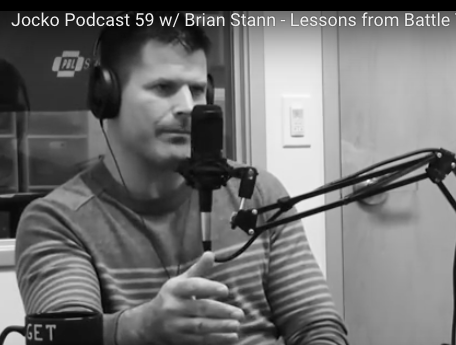
Ran across this YouTube the other day and viewed the whole thing. Gave me lots of new insights on Operation Matador, how WarPig (Weapons Co.) operated, the intensity of 3/2’s fight, and of course on Brian Stann himself.  Stann was the Lieutenant in charge of WarPig 2, and during Matador led an epic fight to secure the south end of the (Golden Gate) bridge. Later, he became a top-notch MMA fighter in the UFC.

This interview is with former SEAL, and now ‘moto motivator’, Jocko Willink.  They cover Stann’s recently published book, Heart for the Fight, which is about Stann’s wartime experiences and how they helped him shape his life.  Great stuff.  Enjoy…

–Ajax

Caution: It starts off with Jocko reading an intense passage from the book about the fiery destruction of an armored ‘trak’ of 3/25 during Operation Matador, which killed several Marines.

Film by 3/2 Marine, Noah Cass

noah-runningShould have put this up awhile back, but got behind… I made contact w Noah Cass a couple weeks ago. In 2005 he was a gunner in WarPig (Weapons Company).  Now he’s made an independent film, The last time I heard true silence, about his experiences in Iraq and his life since coming home. Here’s an excerpt from the web page…

When the war you’ve lived through follows you home, you can’t run away from it, but you can run through it.  

Upon returning from Iraq, Noah struggles to transition back into civilian life. His attempts to reintegrate are repeatedly thwarted by problems he never faced before: aggressive behavior, alcohol, addiction, depression, difficulty holding down a job and holding onto a relationship. After losing more friends to suicide than war, he finds himself hitting rock bottom so he starts running and he never stops.

Now a father and husband, Noah enters a 50-mile wilderness race, pushing his mind and his body to their limits.


My kingdom for a map

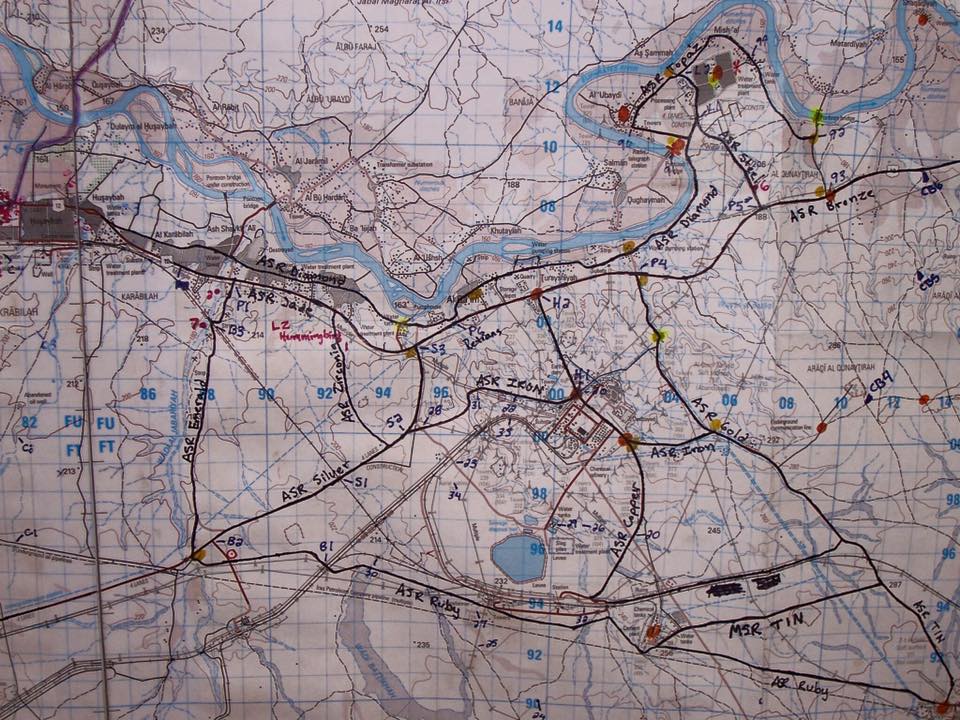
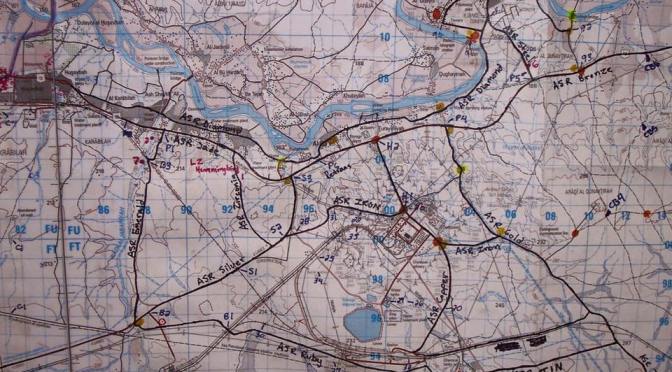
Yesterday I ran across pure gold. This appears to be an annotated operations map from US forces (prob 3/2) in the Al-Qaim area, and it looks like it dates from 2005–at least I don’t see certain battle positions that were set up under 3/6.  It was on someone’s Facebook profile.

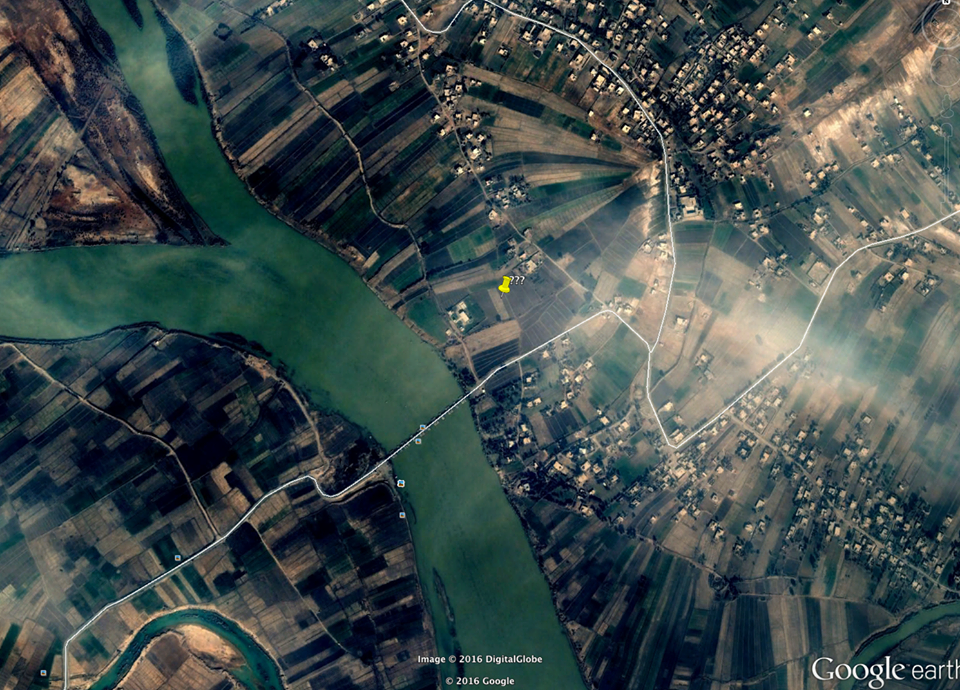
This helps immensely, as I have been struggling to figure out where all the ASRs and MSRs were.  One of the things I’m working on is a Google Earth map of the AO, so if anyone has any amplifying information on this, or (hopefully) has other old maps to share, I’d love to see those.

–Ajax 

ops-map-for-32

Defense of ING compound during Gannon attack

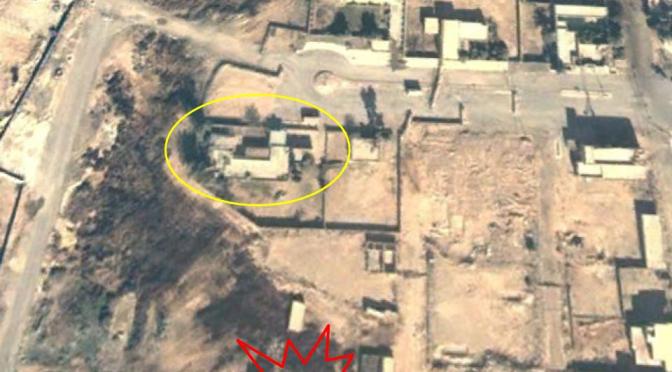
The ING compound was an advanced battle position about 350 meters east of Gannon, consisting of several buildings that provided overwatch on Market Street and parts of Husaybah. India kept it manned round the clock (no Iraqi soldiers were there at that time), rotating platoons through. On the morning of 11 April, 3rd platoon was posted there and became caught up in the complex attack that hit both Camp Gannon and the ING compound.

gannon-and-ing
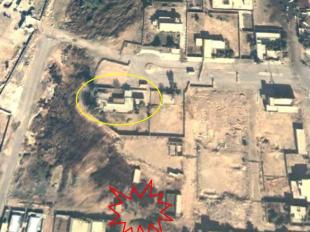
Red bursts show where the 3 truck-bombs detonated. The first hit just south of the ING compound.  The next two hit in front of Gannon’s ECP and P2 tower.
david-pinkham
David Pinkham

David Pinkham has vivid memories of the big attack, and has shared a detailed account of that morning.  He also confirms several things I’ve been trying to pin down, including the location of the 1st VBID strike. I’m posting it with his permission.

My squad was in the building [you indicated]. We had built/improved the sandbag posts on top of the building. By April we were fairly accustomed to regular incoming mortars. On April 11th I was trying to sleep in the morning after a long night of standing post filling sandbags. Some of my squad had just gotten back from the main part of the ING where hot chow was brought most mornings and nights. They woke me up and I decided sleep was more important then food that morning. I heard/felt quite a few mortars land pretty close and I remember thinking how inconsiderate those bastards were for disturbing my precious sleep.

I started to drift off again and then BOOOM! I was thrown from the cot into the wall… An SUV [had] exploded [right outside] where I was sleeping in the ING building… I heard one of my squad mates screaming ‘WERE HIT!!’  All I can see is dust and I have a faint ringing in my ears. I grab my boots, flak, helmet and rifle and start running to the roof where our posts were. My ears start to pick up lots of gunfire on the roof.

ing-closeup
Yellow circle shows building where Pinkham was posted.  Red burst shows roughly where the 1st VBID blew up.

My whole squad was running towards the stairwell for the roof. I was about to take my first step up and another massive blast threw everyone down the stairs and onto the ground. Again I couldn’t hear anything but a faint buzz and dust was so thick I could barely see a couple feet. We all got back to our feet and scrambled to the roof.

There were two posts on the roof facing south into the city where the majority of the attack was coming from. We took to the lip around the wall of the rooftop for cover and began to gain fire superiority. The houses to the south closest to us had been taken by our attackers. As best I could assess there was 15-20 enemy infantry. I honestly don’t remember hearing/feeling a third big explosion, maybe it was the adrenaline. I remember concrete being chipped off the wall in front of us and hitting us from bullet impacts. After what seemed like a split second, time also morphed into an eternity. Adrenaline is a strange rush.

The main firefight died down after about 45 minutes. At one point we had helicopters flying around shooting a couple Hellfires. The last few shots were fired probably an hour or hour-and-a-half after the first blast woke me. I remember Capt Diorio telling us we killed about 35 enemy as reported by the locals. I know three of them had me to thank for that. Then came the waiting game. I had to stay on that roof for 8 more hours because after the fighting died down, it was time for me to take my post.

Besides being a great story, this confirms that the first VBID detonated nearby the ING compound, NOT by the Gannon ECP. The well-known video of the attack is very confusing about that particular point (here’s a detailed analysis of the video).

–Ajax


Monster sandstorm, 26Apr05

Sandstorm Gannon
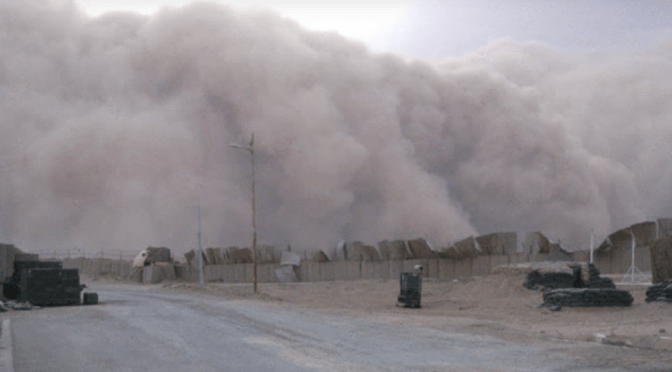
This is clearly a large sandstorm hitting Gannon, probably the big one on 26 April.

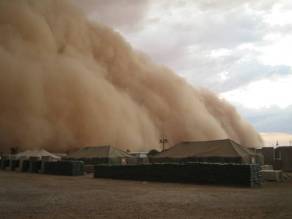
A lot of people remember the huge sandstorm that swept over western Iraq on 26 Apr 2005. There are scads of photos (and several videos) of it on the web, and many military personnel wrote about it.

Several 3/2 Marines remember a sand storm swallowing everything up and covering everything with fine, talcum-powder sand.  Most think it was sometime before Operation Matador (8 May). So, I’m assuming it was the 26 April storm, but am always willing to be corrected.

Joshua Cepeda, in Weapons Co. (Warpig), remembers when the wall of sand hit Camp Al-Qaim:

We quickly tried to cover the trucks as well as we could. But after awhile, it just got completely black. It was impossible to see in that crap. So all operations ended up stopping… We were able to see the sandstorm coming before it hit, so we had a heads-up.

sandstorm-16
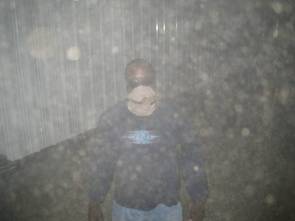
Darkness at midday. Photo from Al-Asad, but it must have been similar at Al-Qaim and Gannon

Some guys went out with gas masks to try and stay out there as long at they could to cover the trucks. I remember them doing a pretty good job but not too long into the storm it got completely dark and not even the gas masks [could] keep the dust out.

If anyone can confirm the date of this big storm, or has photos of it over Al-Qaim or Camp Gannon, please let me know.

–Ajax


sandstorm-al-asad
Another photo from Al-Asad


India almost nailed the cameraman

Dali Markovic thumbSeveral India Company Marines helped me gain clarity on what exactly  happened during the 11 April 05 complex attack on Camp Gannon.  You can see the details they provided in the draft chapter, Attack on Gannon

For example, Dali Markovic of 2nd Platoon provided me the probable location of the enemy cameraman, and a pretty cool story about how India came close to taking him out.

Like most of AQI’s ‘martyrdom operations’, the April 11th attack was planned to maximize the propaganda value.  At least one camera crew was in place to capture the explosions.

gannon-camera-view
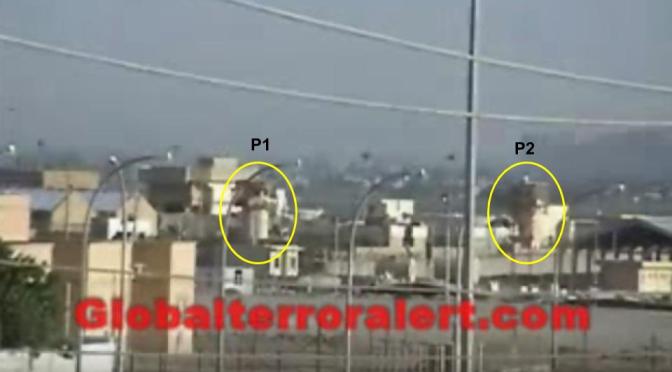
In this a still shot clipped from the video, the towers of both P-1 and P-2 are plainly seen (circles added). Marines in P-1 also spotted the cameraman.

The result was a dramatic video that was distributed to jihadist websites. Subsequently, it was featured on the now-inactive terrorism tracking website, globalterroralert.com, and later migrated to YouTube where it has been viewed thousands of times.

A little-known aspect of the attack is that India Co. came close to killing the cameraman.  Marines manning the ‘P1’ tower spotted the insurgent media team through binoculars.

They were on a rooftop some 800 meters to the southeast of Gannon.  “We called for fire on his location, but it was declined due to the helicopter being too close”, says Dali Markovic, a Team Leader in 2nd Platoon.  “We couldn’t tell they were filming, [but] we considered them hostile due to their activity on the roof at the time of the attack and the fact that we were receiving fire from that approximate direction.”

So, while the bad guys were shooting the video, Markovic and other Marines weren’t just watching them, they had their position dialed in and were trying to kill them.

–Ajax

cameraman
The red triangle shows the probable location of the AQI cameraman.  The red arrow shows the possible path the truck bombs took (needs clarification).  The blue square shows the P-1 guard tower.

Valuable first-hand info

I want to thank the 3/2 vets have been corresponding with me on Facebook. You’ve been providing valuable insights and first-hand info.  Several of my questions have been answered, and other issues have been clarified.  In the case of 3/2’s history, there are many subjects where eye witness accounts are the only possible source.  So it’s pretty cool to be able to chat and talk with these guys.

Here are some of the things they’ve helped me learn over the past few days…

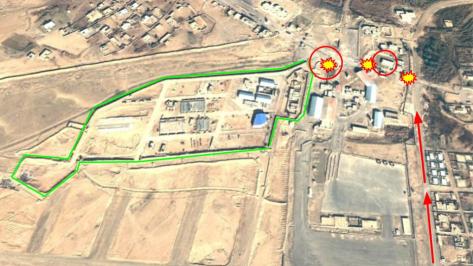
Regarding the attack on Gannon, despite the several written accounts and the famous YouTube video, it’s been hard for me to understand just how the attack unfolded.  But thanks to Aaron Cook, an India Co. Marine who was there that day, now I have this Google map, showing the route the three SVBIEDs took, and where they detonated. That’s a big help, as I work on a detailed page, or series of pages, on the 11 April complex attack.  BTW, if anyone wants to clarify this further, let me know.

Update (18feb17): I now have a draft chapter/section on the Gannon Attack, incorporating a lot of input from India Co. Marines who were there.  That includes a more accurate map. See this link

Update (19jan17): Thanks to a couple of other sources, I now have a much more detailed understanding of where the VBIDs hit, and what else happened.  I’ll be posting that soon.

attack-on-gannon2
Camp Gannon perimeter in green.  Two entry control points (ECPs) as red circles. Little yellow bursts show estimated locations of the truck bomb detonations.  Red arrows show path of the three truck bombs.  Syrian border (with berm) is directly north of Camp Gannon.  City of Husaybah is in lower right/southwest corner. (used with permission)
quell-rifle
Click to enlarge…

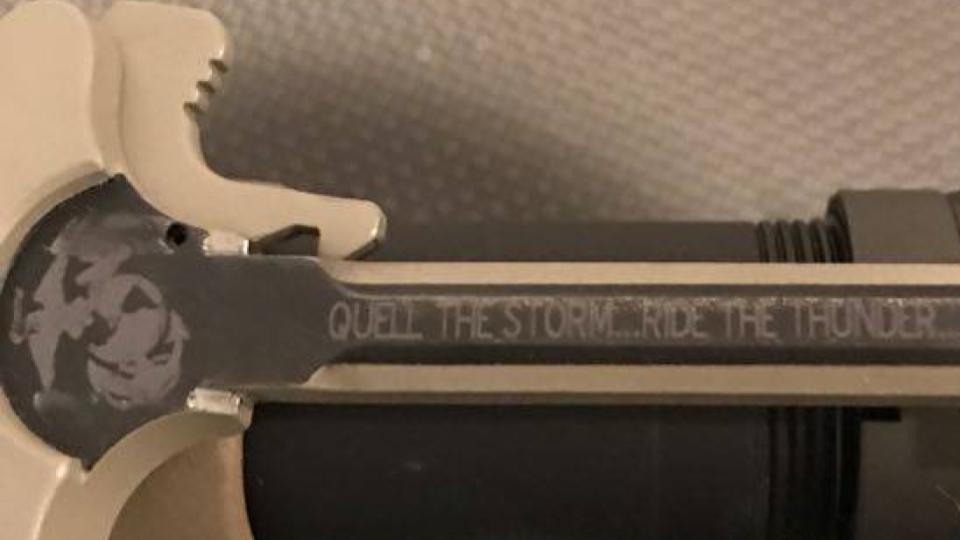
Jeff Maniscalco, from Kilo, 3rd Platoon, gave me two good bits of info. First, he confirmed that “Quell the storm… Ride the Thunder” was in fact the BN motto under LtCol Mundy in 2005.  I’ve been trying to nail that down.  He even shared this photo, of a carrying handle on his custom-built AR-15.

And second, Jeff helped me narrow down the location of the 3/25 AAV that was tragically hit and destroyed by triple-stacked mines on 11 May 2005, during Operation Matador.

aav-strike-loc
Click to enlarge…

I have been trying to figure out that location by correlating photos and video, and written descriptions.  A while back I came up with an educated guess.  But it was good to get a semi-confirmation from someone who was onsite.  He was pretty sure I’d pegged the location accurately.

Another Kilo Marine, Ian Norris, gave me good feedback on a previous blog post about a grunt-level video of Operation Spear.  I wasn’t sure what the platoon/squad was.  Was thinking it was either 3/2 Kilo, or maybe Marines from the 3/25 that came up from Haditha to support the operation.

What I found out was that 3/2’s Lima Co (which I thought was stuck at Al-Asad pulling base security for the whole deployment) sent some elements to be in Operation Spear. Ian knows the guys at the start of the video.  So, I learned a new dimension there.  Will try to connect with those guys and find out more about what 3/2 Lima did.

Anyway, there are already dozens of other examples where first-hand accounts from 3/2 Marines have really deepened my understanding.  I don’t think I could really tell the story without these guys sharing their experiences and insights.

–Ajax

Ammo Marines made YouTube History

Not really a 3/2 story, but adds a little flavor and opens up another window to explore.  I need to find out more about the ‘Gunrunners’ helo squadron…

Anyway, it’s hard to remember, but in 2005 YouTube was still a startup and hardly anyone knew about it.  But a few Marines from Marine Aviation Logistics Squadron 26 (MALS-26), working out of Al-Qaim, put something together that made history… sort of.

its-tricky-marines
MALS-26 quasi-famous rendition of “Its Tricky”

Apparently, this was one of the first parody music vids on YouTube that went ‘viral’, so it became part of digital lore.  Later, a YouTube ‘historian’ (who knew?) tracked it down and restored it to its rightful place.

They included their names at the end, so it was easy to find this article from marines.com, which of course is all serious and stuff (in contrast to the video).

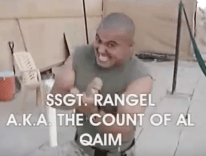
“The birds support the ground guys.  When they get the call the birds go out, and if we’re not building ordnance what are they going to shoot?” says SSgt Danny Rangel, the NCOIC, who will forever be known to the Interwebs as “The Count of Al-Qaim”.

So, there you have it.  A little YouTube history, and a little Camp Al-Qaim history.  And some new questions to explore.
Such as…

Did Cobra attack helos operate directly out of AQ?count-of-aq

How many  were stationed there?

How did the Marine Air Support system work in 3/2’s AO?

–Ajax

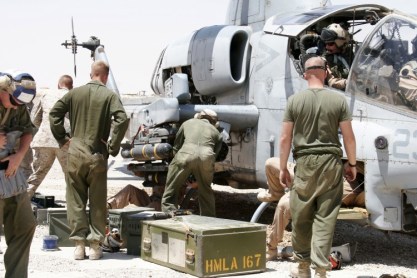
Update (10jan17): OK, already started finding info.  Confirmed that AH-1W Super Cobras flew out of Camp Al-Qaim during Operation Matador and Spear.

supercobra-at-aq
Al-Qaim, 17 June 2005 — Marines with HMLA 269, Detachment Al-Qaim, reload an AH-1W Super Cobra before it goes out on a mission.  (USMC)

They were part of Marine Light/Attack Helicopter Squadron 269 (HMLA 269) the “Gunrunners”, operating mainly out of Al-Asad.  Still not sure if they kept birds at AQ all the time, or just rotated in and out as required to support big ops.

The caption mentions ‘Detachment Al-Qaim’, so maybe they had several helos bed down at AQ.  See full article.

BTW, The photo here prob shows some of the MALS-26 guys uploading ordnance.

Grunt-level video of Spear

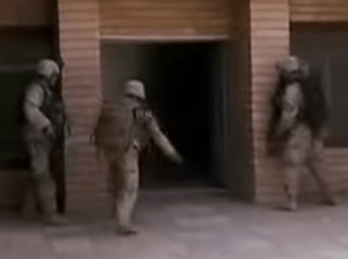
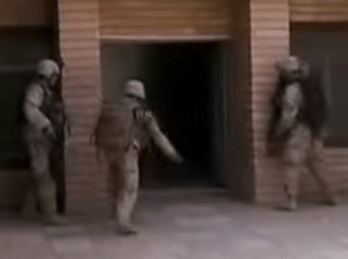
This is a really interesting video, clearly taken by a Marine from either 3/2 or 3/25 (I’m still trying to figure out which), showing the operation up close and personal.  Among YouTube war videos, it’s unique in that it’s over an hour long, and doesn’t have a bunch of distracting edits or advertising.  It also shows many interesting aspects of the operation, and what it’s like to be a grunt pushing through an Iraqi city infested by insurgents.

For viewers who were there, this may conjure up memories of the event.  If anyone knows the guys in this squad, or has info on the video, let me know.

And for non-Marines who watch this with patience and attentiveness, it reveals fascinating details.  For example, listen to the Squad Leader’s mission brief (in the dark) at 10:53, as he readies his men for action.  See a tank demolish a building at 28:55 and watch how Marines do room clearing, starting at 47:50.

fragging
Military Operations in Urban Terrain (MOUT) in Operation Spear, June 2005

Note: The first 10 minutes show a large sandstorm sweeping over Al-Asad so you may want to skip that.

Oh, and high-level language warning. These are Marines, unfiltered…

–Ajax

Update (13jan17):  I found out this was 3/2’s Lima Co. I thought they were at Al-Asad pulling base security for the whole deployment, but in fact they sent some elements to be in Operation Spear.  My source knows the guys at the start of the video.  So, I learned a new dimension there and will try to find out more about what 3/2 Lima did.